A Loaf of Bread A Week
Published: 20 March 2026
By Cianna Lee
Special to the Doughboy Foundation web site
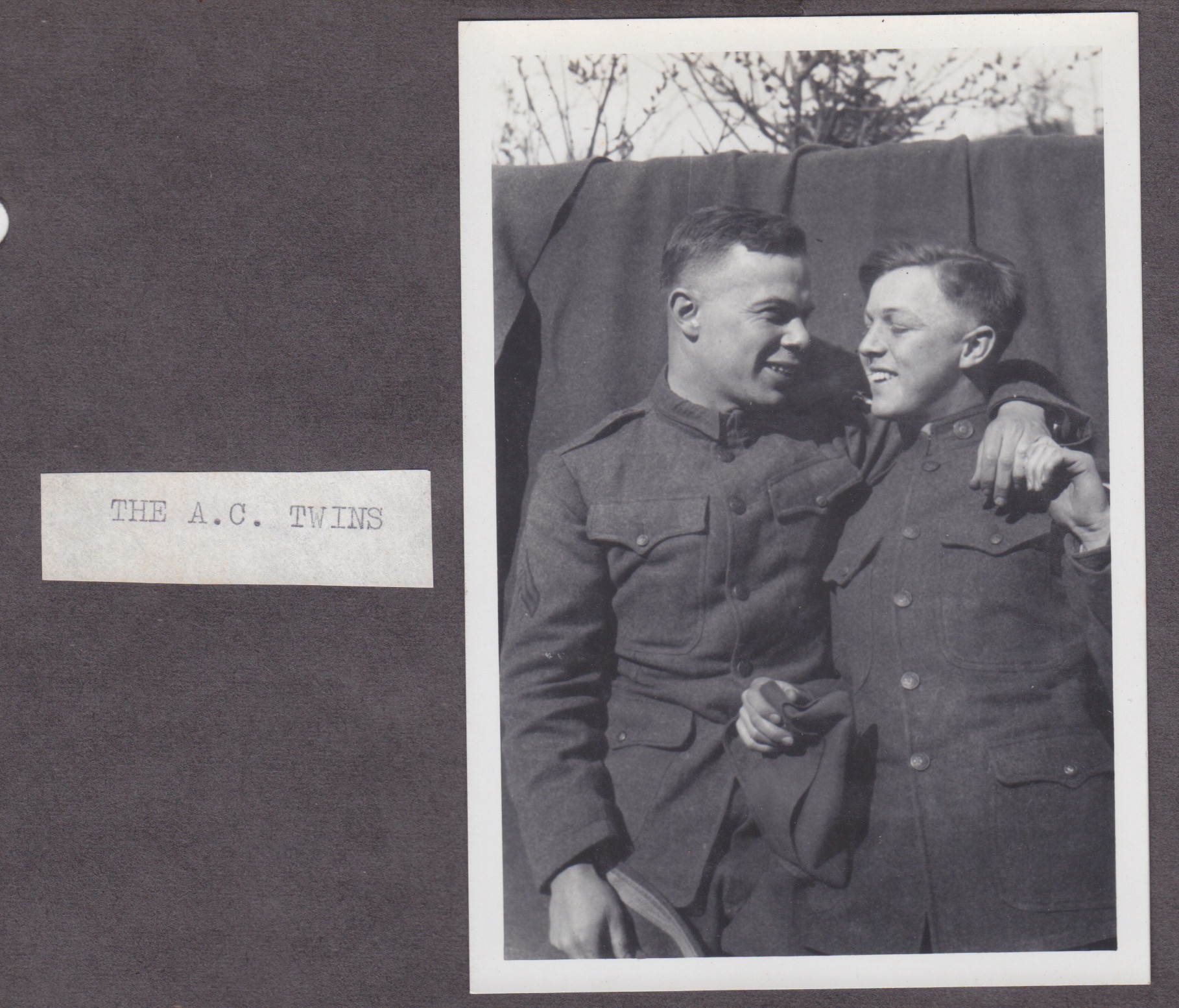
Image of McCorkle & Thomas
Eugene “Reynold” Thomas (right) with his high school and Marine Corps buddy Lou "Mac" McKorkie in France during World War I.
Eugene “Reynold” Thomas was born in 1898, in Pennsylvania, to George and Evelyn Thomas. In 1917, he would enlist in the war as a marine, and see action. After the armistice was signed, he was sent to occupy Germany with the rest of his detachment. During that time, he sent a series of letters to his family describing what it was like in Germany at the very end of the war and during the German occupation (1919). (One of his stories about his Occupation experiences, “Seeing Tina Home,” was previously published on the Doughboy Foundation website.) Later, he wrote a story highlighting some of the experiences he had with his high school buddy “Mac” during the war and during the occupation that followed. In the second of four articles showcasing his WWI experiences, here’s more from Thomas about his adventures with (and because of) “Mac.” (Part one of the series is here.) (Part two of the series is here.)
Mac’s job was to see that men transferred into the Division or returning from hospitals had transportation to their respective units. Once in a while I would be detailed to assist him.
Of course, the business of providing extra chow now and then also fell into a routine in a short while. In fact it was a little easier to do up here than down in the regiment. For some reason there seemed to be more loose time in which to work at it.
Then, too, it was good to be soldiering with Mac again, if you can call this soldiering. Besides, we’d made a number of new friends up here, even among the Army.
Some of these guys had never experienced the joy of eating outside of the chow line, where you stand in a long line, rain or shine, holding out your mess gear for some cook to dump whatever he wants into it, instead of sitting down in comfort at a clean table with four or five friends to a meal that has been prepared especially for you.
Just one sample meal and boy, they loved it. Yes sir, I rated well again as a promoter of extra fine chow – as long as the war and the language raged in nothing worse than French.
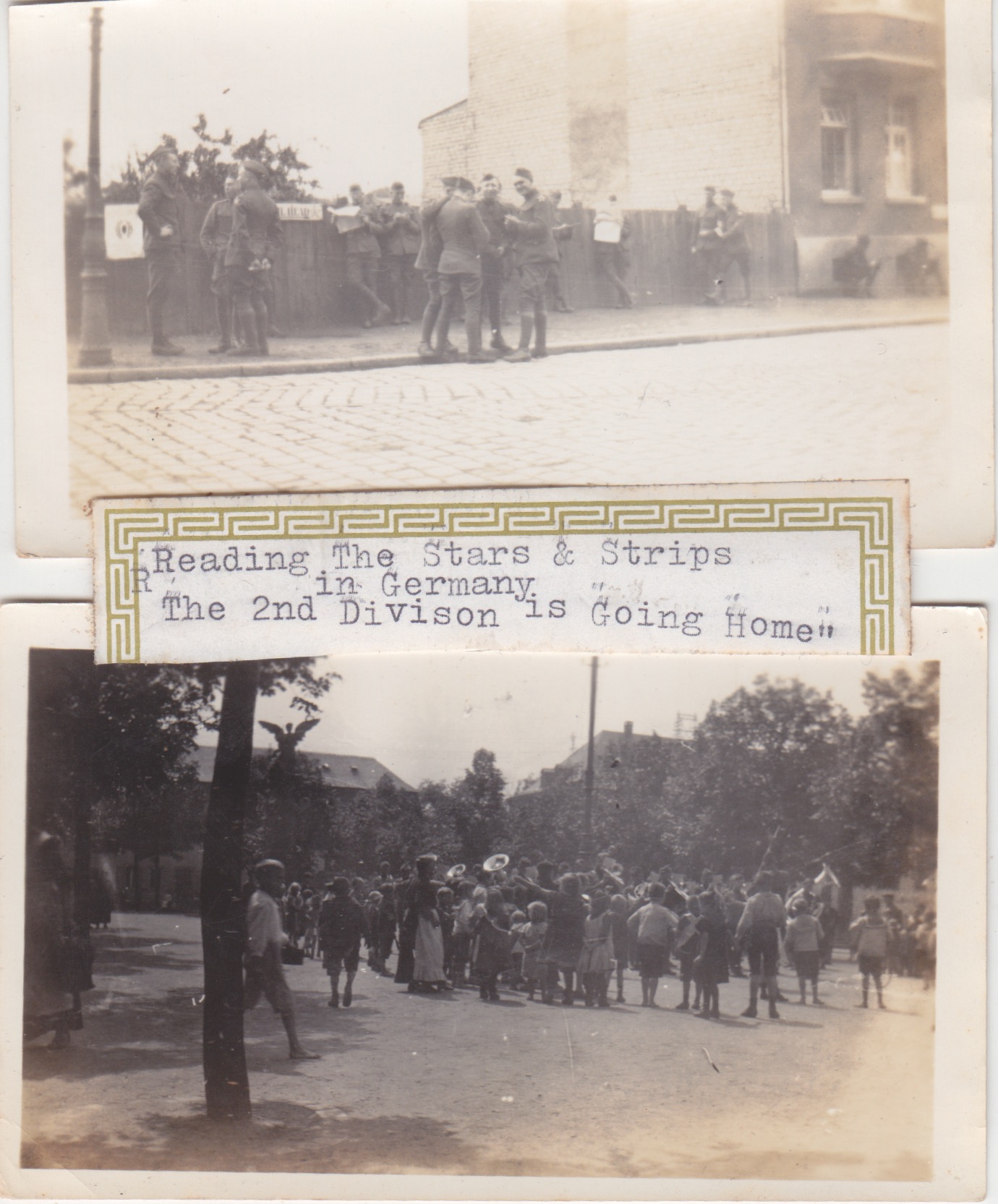
But then came an armistice. They knocked off fighting and started marching (we at Headquarters do it in trucks). Soon we marched right into a brand new language. My prestige was ruined. Poulet, Pomme de terre, des oeufs, etc., meant nothing to the civil population of Germany. Besides, it was against orders to even talk to them. “Fraternizing with the enemy” was a serious offense for both sides. There sure was no danger of me breaking this order. I couldn’t say a word.
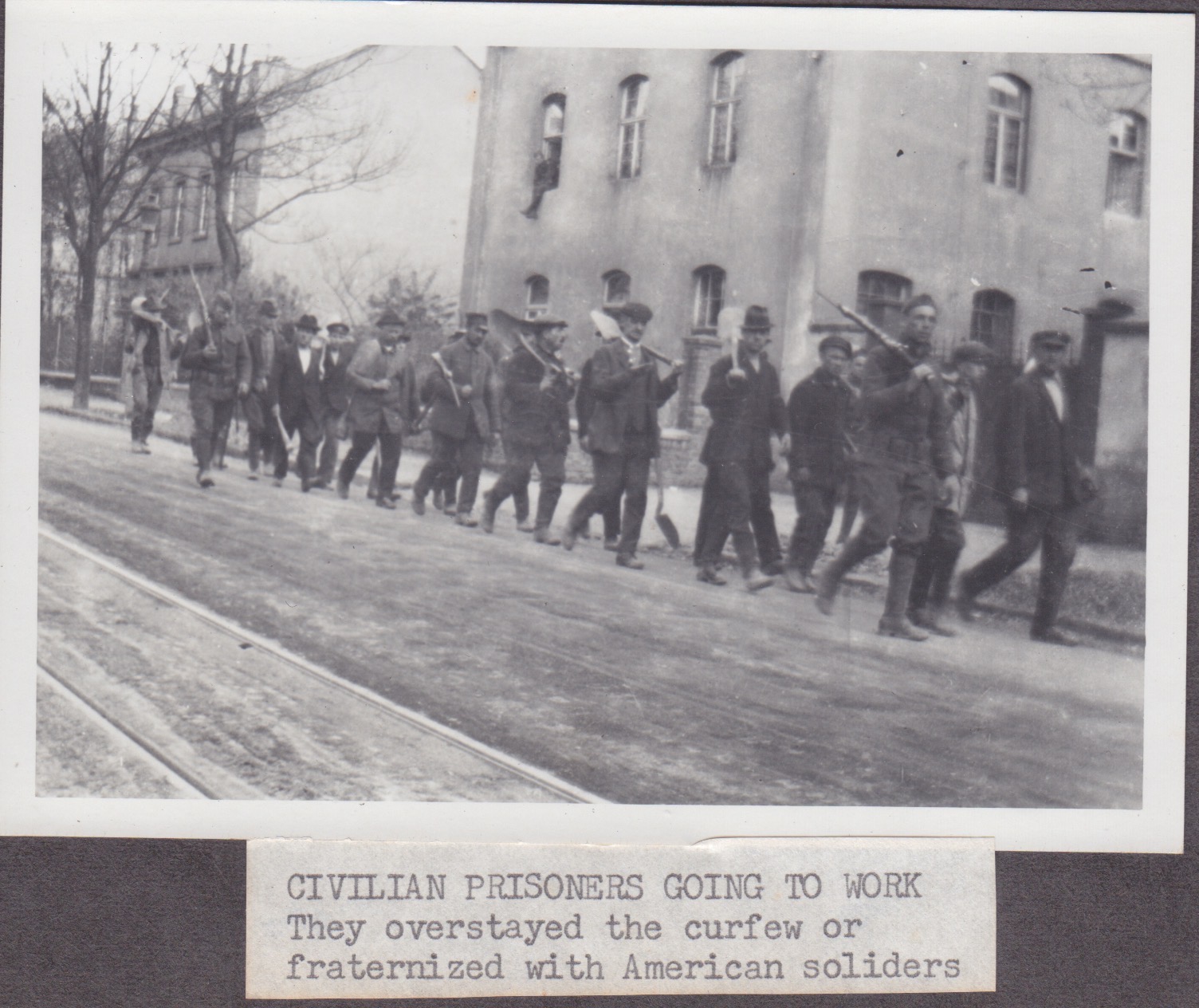
Even when someone would talk to them, another problem in this new country was that they seem to have no food to sell or trade except potatoes. Eggs, chicken, rabbits, flour, sugar or beef could not be bought for love nor money or even for soap – and man believe me, I offered all of them. However, Mac assured me, “Don’t worry. I can handle this table talk.” He claimed he was in familiar territory, that his mother was German born and that he could talk the language.
It looked as though he were telling the truth, too, for we had been stationed in Neuwied am Rheim for less than two weeks when Mac made a deal with a German civilian to rent a nice room for the two of us for “a loaf of bread a week.” The room was only a ten minute walk to the big stone schoolhouse in which most of our headquarter offices were located.
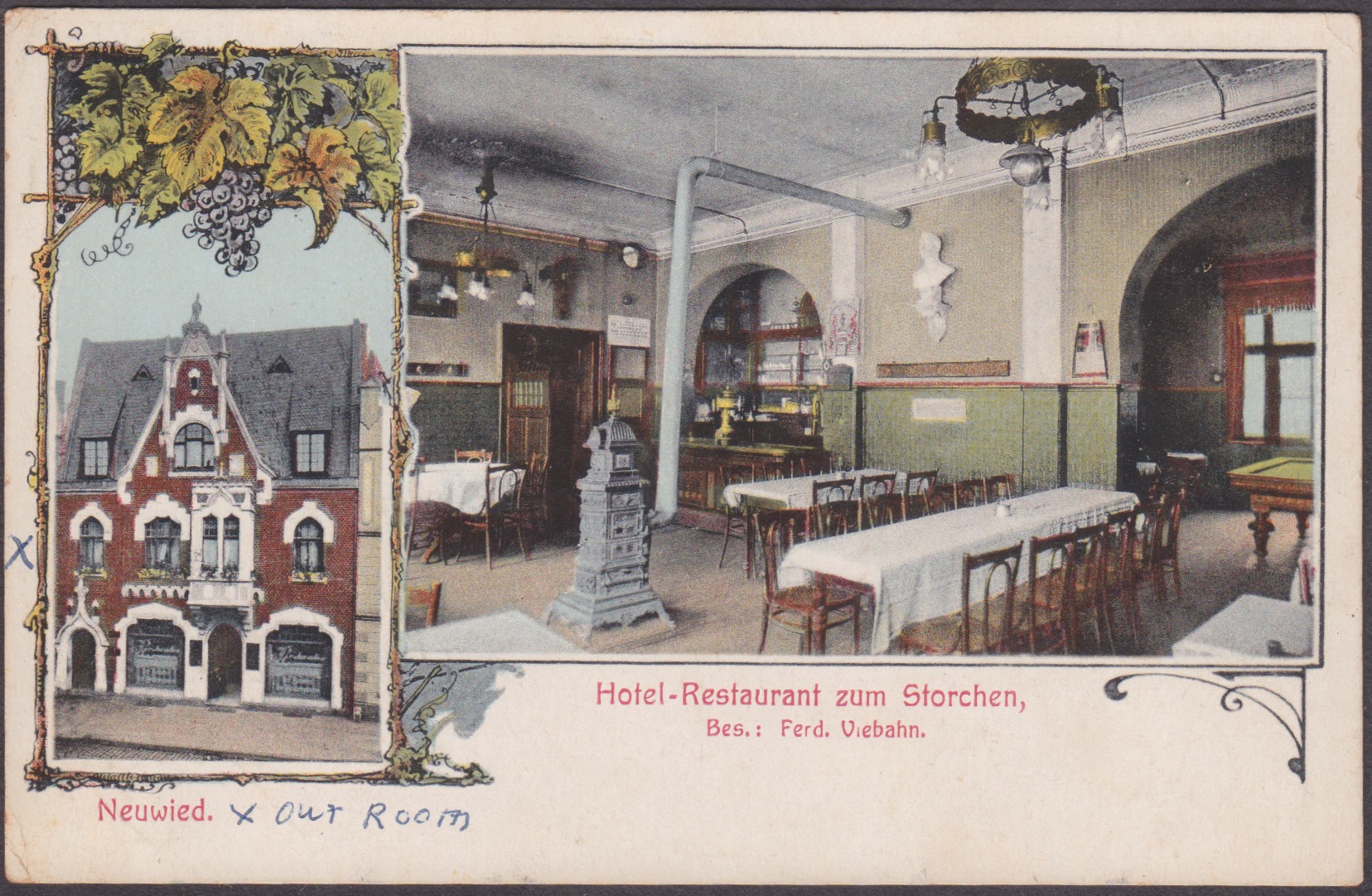
A postcard of the hotel in Neuwied am Rheim.
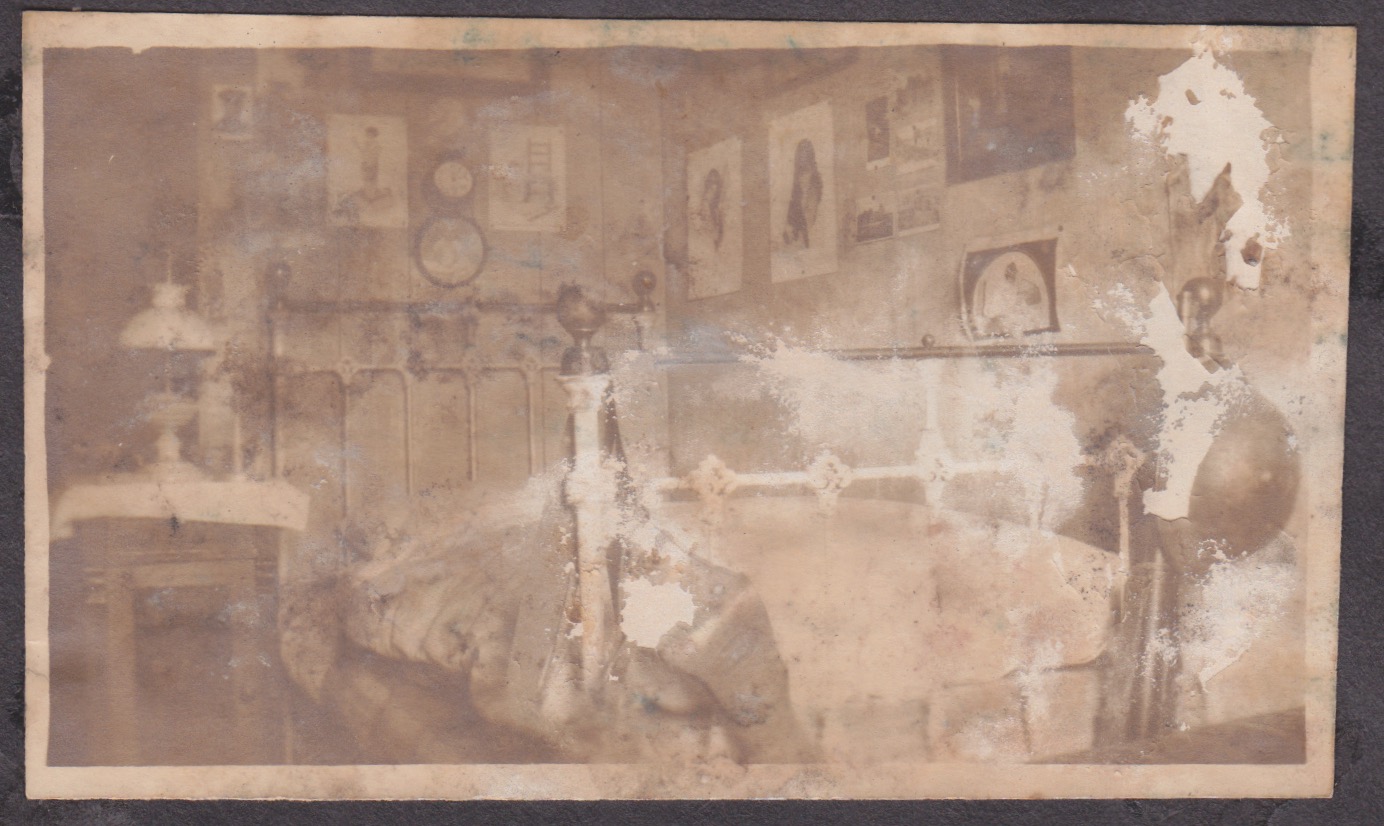
A photo of the room where Reynold and Mac stayed in Neuwied am Rheim, rent negotiated by Mac.
Although we, the enlisted personnel, officially belonged to the “Marine Detachment” and had a commanding officer, a second lieutenant whom we seldom saw, the actual authority over us was the officer we worked for in headquarters.
These officers didn’t care where or how we lived as long as we did our job and got to work on time, so there was little concern and no objection when we asked for permission to leave the detachment barracks for our new quarters.
There was plenty of food, such as it was, at the detachment mess, but who wants to walk a mile and a half, rain, snow or shine, stand in a barnyard holding out a shallow tin pan for a mess of army slop when a little conniving could make it possible to have a home-cooked meal served on a clean white table right in your own billet.
Well, Mac and I discovered a little conniving that would do just that. I include Mac for some credit in this off duty piece of brilliance only because he finally agreed to try my idea.
Since we’ve been stationed here in Germany with the Army of Occupation, our job at headquarters has evolved into a sort of reception committee to receive “casuals” returning from hospitals and replacement depots back in France and provide them with transportation to their various regiments. We ship them out to the units designated by their orders in trucks or cars according to the number of them and to their rank.
These men arrive at the railroad, where we meet them, in groups of all sizes, from just a few men to a trainload and they all carry enough rations for the entire trip.
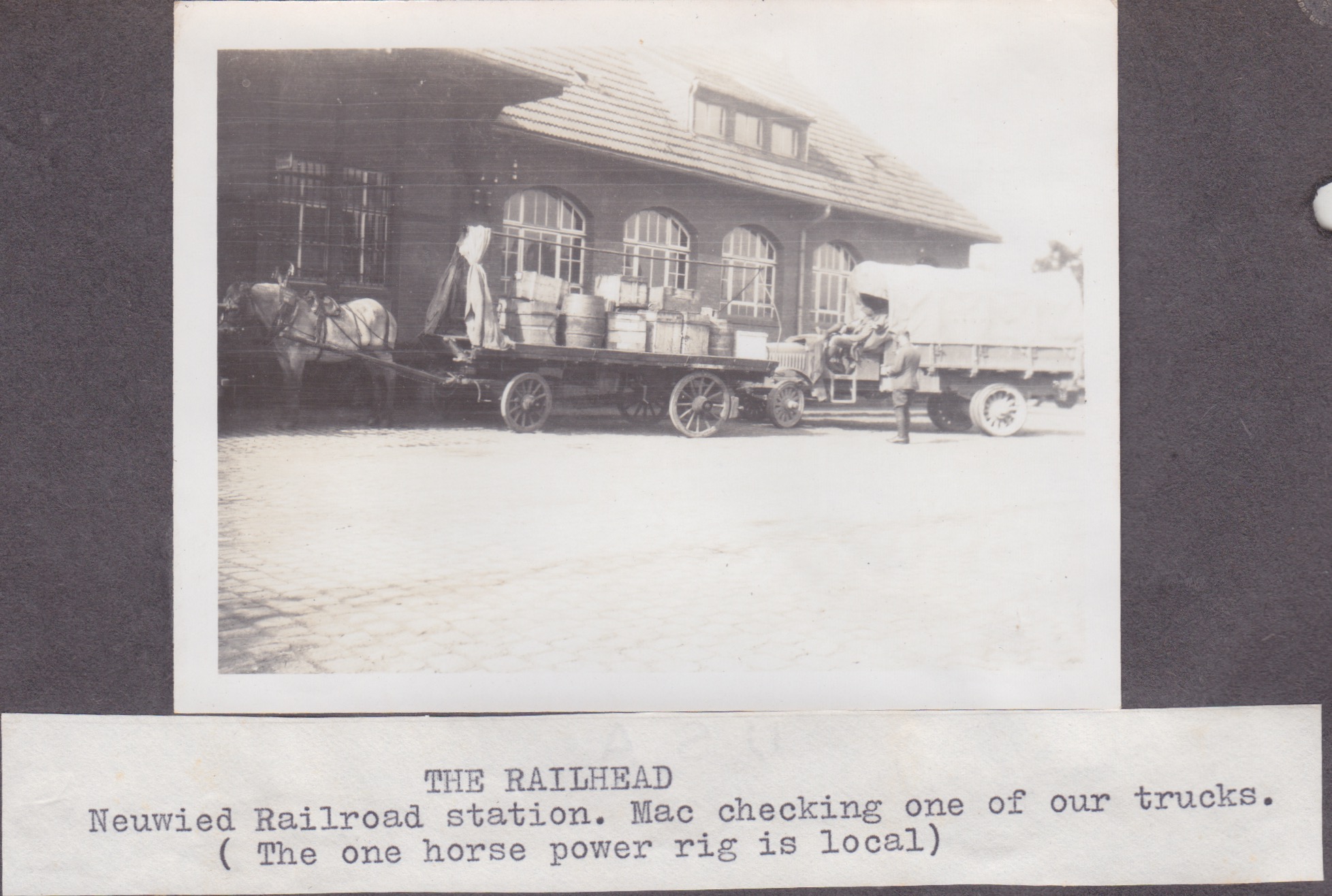
Of course, according to standing orders any rations left over from the trip were piled at one end of the station platform for delivery to the Headquarters Detachment Supply Sergeant – except maybe for a few cans of fruit, vegetables, coffee or sugar, lard or Crisco – little things that might be useful at the billet.
So, when on one occasion a trainload of nearly a hundred men arrived to charge of a senior casualty officer, a colonel no less, completely rationed for the three-day trip from some replacement depot in southern France, Mac and I had a delightful thought as we pondered on the amount of surplus food that would have been to be moved.
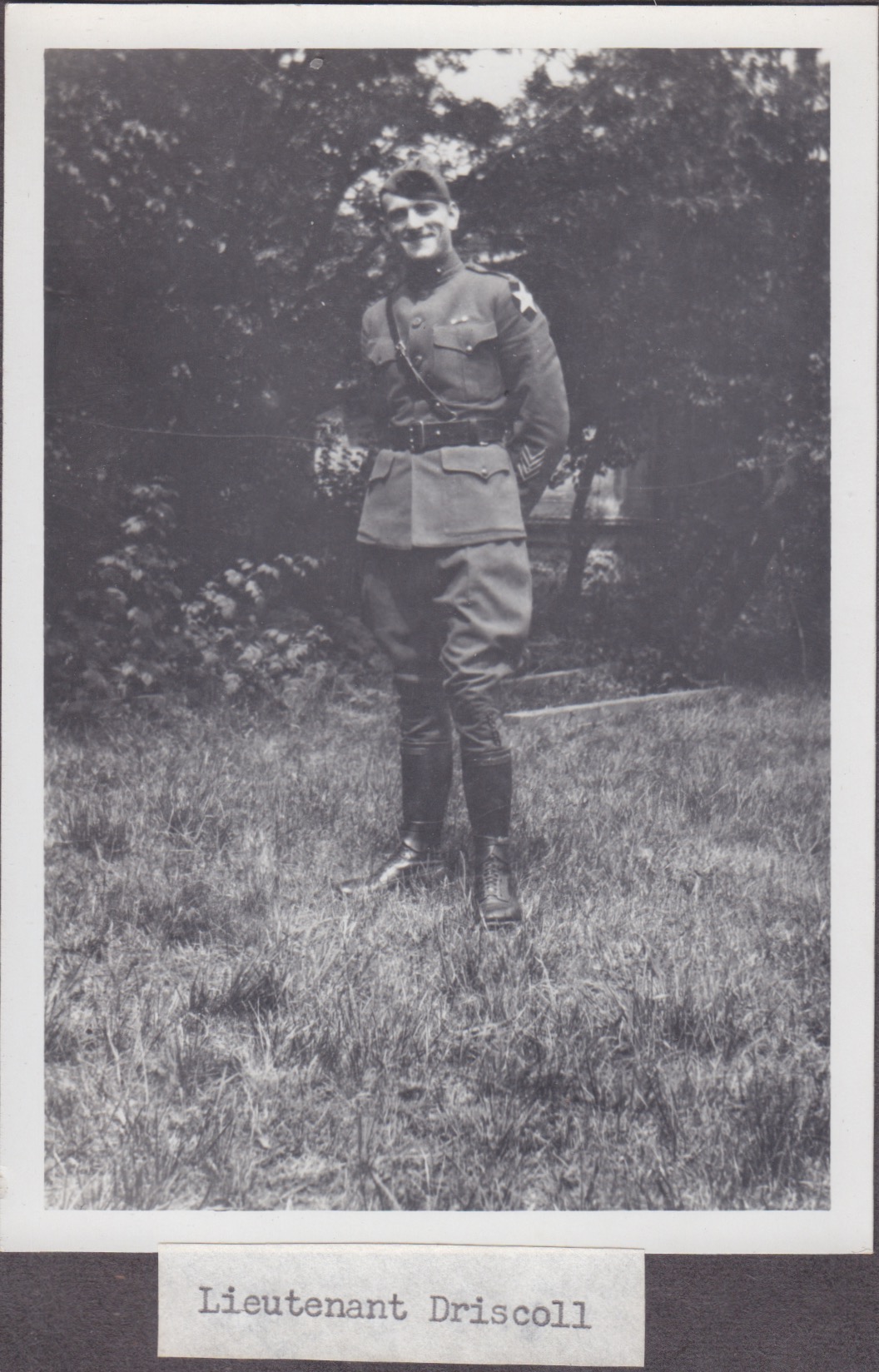
The thought certainly was not of the extra work involved in handling this mob, but on the amount and accessibility of some extra food. Our situation though was enhanced by the fact that our own officer, handsome Lieutenant Driscoll, having pressing social engagements in Colbenz, had given full details and instructions to Sergeant McCorkle and then departed without waiting for the train’s arrival. This put Sergeant McCorkle in full command of the operation. Sergeant McCorkle knew his stuff and I was his able assistant.
Everything went off smoothly. The casualty officer’s list matched Mac’s perfectly, for both officers and men, name for name. This made advance orders detailing men to their several regiments much smoother. We had already posted signs along the platform to indicate the assembly points of the various regiments and the men were collecting nicely at the proper stations.
Mac had a parade ground manner that he enjoyed using in the presence of strangers, especially strange officers. He used it on me now, as he turned and ordered, “Corporal, phone division garage for ten trucks and order one car to take the Casualty Colonel to 4th Brigade Headquarters. Then got two motorcycles with side cars for the other officers, one to go to 23 Infantry Headquarters and one for the 12th Field Artillery. Have all these railway cars cleaned out and the men standing by in regimental groups before the trucks get here. I’ll be back in half an hour.”
“Very well, Sergeant.” He was like that when Lt. Driscoll was away, giving me all the dirty work while he fraternized around in a Dodge touring car with officers.
I turned to the Senior Casualty Sergeant and said. “Sergeant, if you’ll turn your birds to, have them clean all dirt and straw out of those cars and pile it down there and stow all rations at this end of the platform, we’ll have all hands back to their outfits before dark.”
He had them stepping to it as I left to telephone the garage officer for transportation. What a sight enlivened my eyes as I returned to the platform! That pile of “rations”! It was already waist high and men were still heaping it on. Chow by the cases! Sacks of sugar, flour, cartons of butter, cases of coffee, jam, canned beef, fruits, and vegetables! Even a side of beef.
“How come all this chow is left over Sergeant?” I asked, trying not to let my enthusiasm show. “Didn’t you fellows eat on the way up?” “Hell, yes, but no thanks to the guy that issued all this stuff, with no kitchen car to cook it in. We ate off the Red Cross at every stop and”. But I was hurrying back to the telephone. I had the garage officer again. “Division Adjunct’s Office calling sir, Corporal Thomas speaking. Request our requisition for ten trucks be made eleven, sir. Yes sir, miscount… sorry sir, my fault. Yes sir, the trucks are piling in now. I can hear them. Fine, thank you sir.”
Outside the ten trucks had pulled in. Mac was back and loading the men in. I didn’t have time to speak to him then. Anyhow, the trucks were making too much noise for a confidential conversation, so I turned to assigning the proper trucks. A glance though assured me that the pile was still there.
I was trying to tell directions to the next to last driver over the deafening sound of bursting exhausts and had not heard nor seen Mac until he screamed in my ear. “Hey, what’s the idea of the extra truck? I told you ten.” “My gawd, you didn’t send it back, did you?” “Not yet, but…”
“Man, that’s our private chow wagon. Give me a half a dozen men ‘till I load that chow on a truck and send it over to the billet,” I whispered at the top of my voice.
Mac started to argue. “You damn fool, you can’t get away…”
Just at that moment I happened to look up and half way down the platform saw our plump little ole casualty colonel dodging among the soldiers and their cumbersome gear and looking very anxious about something. I tapped Mac on the shoulder and pointed to the Colonel with my finger, then shouted, “I bet he can’t find his transportation. You go look after the Colonel and I’ll look after this truck.”
From the expression on Mac’s face as he hurried away, I bet I wouldn’t have liked what he was saying, if I could have heard him.
I quickly returned to the next group waiting to be placed on trucks. I picked out four of them. We had that extra truck loaded in a few minutes. I climbed up beside the driver, the men on the boxes behind and we were off to the billet.
Just beyond our billet on Heddesdorfestrasse, the artillery brigade had about thirty men stationed in what was once a store of some sort. Entrance to these quarters was from the street, but just around the corner and half way up the block an alley cut in, led behind these quarters and right up to our back door.
But I couldn’t unload a truck load of stolen goods right at our door. A few doors above the alley and on the Main Street, the Provost Marshal had an office and a little way beyond that was an officers’ mess for a group of General Le Jeune’s staff.
A fine place to unload contraband! And just as I was thinking hardest where I could unload it, the driver barked up again. “Well, you found out yet where this artillery kitchen’s going to be? If that’s the alley you’re talking about, I can’t get this Packard up there. You birds will have to carry it.”
Even as I was stalling for time by explaining to him why he could not unload on the sidewalk at the alley entrance, he’d stopped the truck and was backing up to the curb— between the Provost Marshal and the commanding general’s mess.
The men were anxious to get back too, and had the tail gate down before we’d scarcely stopped. There was no stalling now, the men were swinging the stuff to the ground with a will. They were actually sweating and so was I, but for a different reason. Anyhow, it’s all unloaded now.
I turned to the driver, “Take these men back to the station and you report to the Sergeant.”
And there I was alone with my pile of swag in the midst of the powers that be.
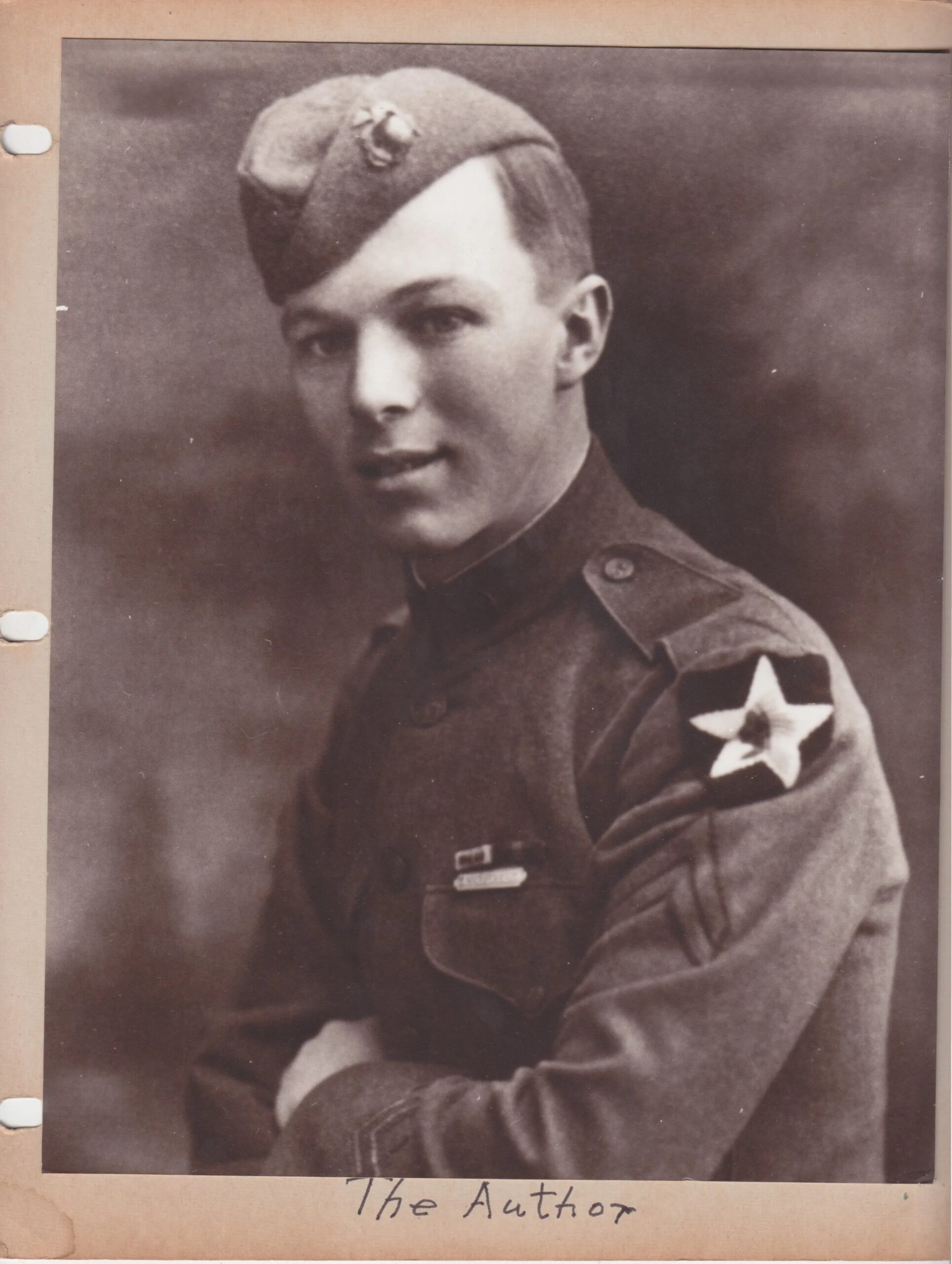
Eugene “Reynold” Thomas
A pair of MP’s had watched us unload from across the street. Now they were swaggering across to me and my pile, thumbs caught under the front of their belts and that “I am king” expression, which seems to go with the red arm band of their breed.
“What’s the idea, soldier, all these stores… and piled in the middle of the sidewalk?” I was hoping they would think the sweat standing out on my brow came from the recent toil.
“You birds would come over and say something like that now. Why the hell couldn’t you say something while that working detail was still here. This stuff is for the artillery detachment; they are setting up a kitchen for them. I’m only the guard, and not the working detail. The stuff will have to stay ‘till the sergeant gets here with some men to carry it back.”
(I was just patting myself on the back for some fast thinking, when the MP Sergeant spoke up), “I don’t care who moves it or how – it’s going to get off this sidewalk and quick or —,” “Well, I’m willing to move it, but it’s my neck if half of it is stolen while I’m taking one case in… now a detail will be along here any min—-,”
“Turn to, we’ll see that no one swipes it. Tony, stand by with this guy a few minutes…”
Tony wasn’t such a bad guy at that, that is for an M.P. He even lifted a case or sack on my back now and then. He also shooed away Dutchmen who stopped occasionally to feast their eyes on that food and thus did away with undue attention! Then, too, Tony’s presence gave a sort of official aspect to the operation.
Tony went so far as to collaborate with me on my profusely expressed opinions of truck drivers that were in too big a hurry. He also suggested it wasn’t necessary for me to carry the stuff any further than just off the sidewalk – so I did just that!
I dragged the stuff off the sidewalk, around the corner behind the buildings where it was out of sight from the street and from whence I could lug it into the billet at my leisure…
So under the general’s nose and the Provost Marshal’s protection, I had the stolen goods “off the sidewalk” and safely cached under beds, in cupboards, bureau drawers and any place in the billet that would conceal before Mac got home from taking care of that Casualty Colonel.
In August of 1919, Reynold would be sent home to New Jersey.
He would move to Harvey Cedars, NJ, working in his uncle’s eel grass business. Later, when he was working in Manhattan, he met his wife, Josephine Lehman, an editor and ghost writer for Lowell Thomas. They married in 1931 and two years later, at the depth of the Great Depression, moved back to Harvey Cedars, where he became a fisherman in order to “ride out the Depression.” He did not succeed at this and eventually started a dredging company, which became a success. In 1955, he was elected mayor, and continued to be a public servant until his death in 1983. Reynold’s daughter, Margaret, is a writer with Down The Shore publishing, writing about local history and a book focused on her mother’s participation in World War I. You can find her books here.
Cianna Lee is a Senior at Bennington College in Vermont.
External Web Site Notice: This page contains information directly presented from an external source. The terms and conditions of this page may not be the same as those of this website. Click here to read the full disclaimer notice for external web sites. Thank you.