Verdun and the Price of Endurance
Published: 24 February 2026
By Daniel Dodds
via The Havok Journal website
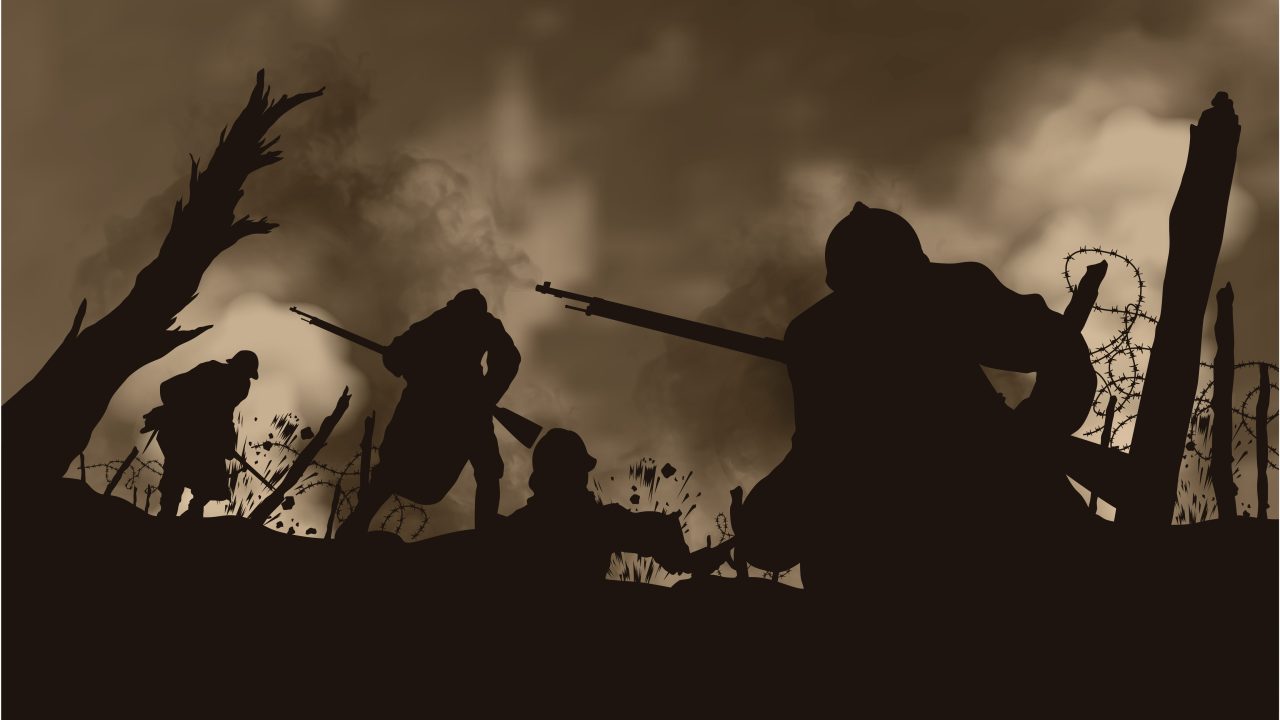
Verdun header image
After the U.S. declaration of war, the American Expeditionary Forces (AEF) under General John J. Pershing were determined to avoid being mired in similar battles of attrition.
The Battle of Verdun, fought from February 21 to December 18, 1916, stands as one of the longest and bloodiest engagements in modern military history. Located in northeastern France, Verdun became the site of a grueling confrontation between the French and German armies during World War I. What began as a calculated offensive by the German High Command transformed into a symbol of French national resistance and a harbinger of the attritional warfare that came to define the First World War.
This paper explores the origins of the battle, analyzes its significance from both French and German perspectives, discusses the tangential connection to American involvement in the war, and evaluates how Verdun shaped future military doctrine.
Origins of the Battle: Planning the Unthinkable
By the end of 1915, World War I had devolved into a bloody stalemate along the Western Front. Despite massive offensives, neither side had achieved a decisive breakthrough. In this context, German Chief of the General Staff Erich von Falkenhayn proposed a new strategy: rather than seeking territorial gains, he aimed to “bleed France white” through a war of attrition.
Verdun, a historic fortress city with minimal strategic value but immense symbolic importance to the French, was selected as the target. The Germans believed that the French would be compelled to defend Verdun at all costs due to its cultural and national significance. Thus, the Germans planned to use artillery superiority and targeted offensives to inflict maximum casualties, anticipating that the French would continue to pour men into a hopeless defense.
The German plan, known as Operation Gericht (German word for “Judgment”), relied on the assumption that France would commit to an unsustainable defense, thereby weakening itself irreparably. The offensive began on February 21, 1916, with a massive artillery bombardment that included over one million shells in the first nine hours. The German army quickly overran key forward French positions, including Fort Douaumont, one of Verdun’s main defensive strongholds.
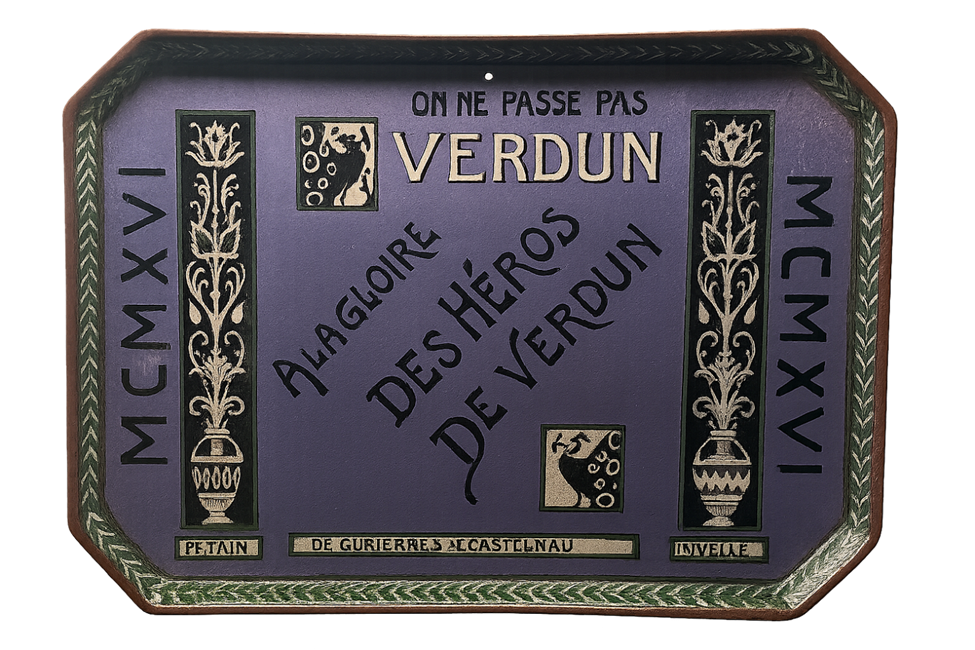
Ceramic plate with the inscription “They shall not pass Verdun to the glory of the heroes of Verdun 1916 from Guerrieres to Castelnau watched over,” located at the National WWI Museum & Memorial in Kansas City.
The French Response: “They Shall Not Pass”
Despite early German successes, the French response was immediate and resolute. General Philippe Pétain, who would later become a controversial figure during World War II, assumed command of the defense. Pétain implemented a methodical rotation system known as the “noria,” which enabled French units to cycle in and out of the front lines, reducing battle fatigue and sustaining morale. Over 70 divisions passed through Verdun during the battle, with some serving brief but intense tours of duty.
Pétain’s leadership and insistence on maintaining logistical supply lines, especially the vital “Voie Sacrée” (Sacred Way) road that supplied the front, were critical in sustaining French resistance. Morale was also buoyed by the rallying cry “Ils ne passeront pas!” (“They shall not pass!”), which became emblematic of French defiance.
The battle soon degenerated into a war of attrition, with both sides suffering catastrophic losses. Artillery dominated the battlefield, causing an estimated 70% of all casualties. Conditions were nightmarish: soldiers fought in mud-filled trenches under constant shellfire, with little food, water, or medical care. By December 1916, the French had regained most of the ground lost earlier in the year, but at a terrible cost.
Strategic Importance: A Tale of Two Nations
From the German perspective, Verdun was a strategic gamble intended to weaken France irreparably. Falkenhayn believed that France’s deep national pride would compel it to defend Verdun regardless of the cost. If the French bled themselves dry defending the fortress, Germany would gain the upper hand on the Western Front. However, this strategy underestimated French resilience and overestimated the logistical capabilities of the German army. As the battle wore on, German losses mounted, and the supposed offensive became a quagmire. Worse, it drained resources and attention from the Eastern Front and the planned Somme offensive in mid-1916.
For the French, Verdun became a symbol of national unity and resistance. While the original plan may have been reactive rather than preemptive, once the battle commenced, the French high command understood the political and emotional weight of the site. President Raymond Poincaré and military leadership emphasized the defense of Verdun as essential to the preservation of national honor. The battle also served as a testing ground for new artillery tactics, troop rotations, and decentralized command structures. Pétain’s approach, focusing on morale, logistics, and artillery, marked a departure from earlier rigid French doctrines like offensive to the extreme, which had proven disastrous in 1914.
America’s Involvement: Indirect Connections through Strategy and Morale
Although the United States did not officially enter World War I until April 1917, the Battle of Verdun had a subtle but critical influence on American public opinion and strategic orientation. American observers, including military attachés and journalists, closely followed the events at Verdun, interpreting the prolonged battle as emblematic of the horrors of modern war. The scale of carnage shocked the American public and gradually eroded the illusion that the war was a quick and decisive affair.
Read the entire article on The Havok Journal website here:
External Web Site Notice: This page contains information directly presented from an external source. The terms and conditions of this page may not be the same as those of this website. Click here to read the full disclaimer notice for external web sites. Thank you.