The Short Life of America’s Anti-Tank Rifles
Published: 23 March 2026
By Bruce N. Canfield
via the American Rifleman website
antitank2
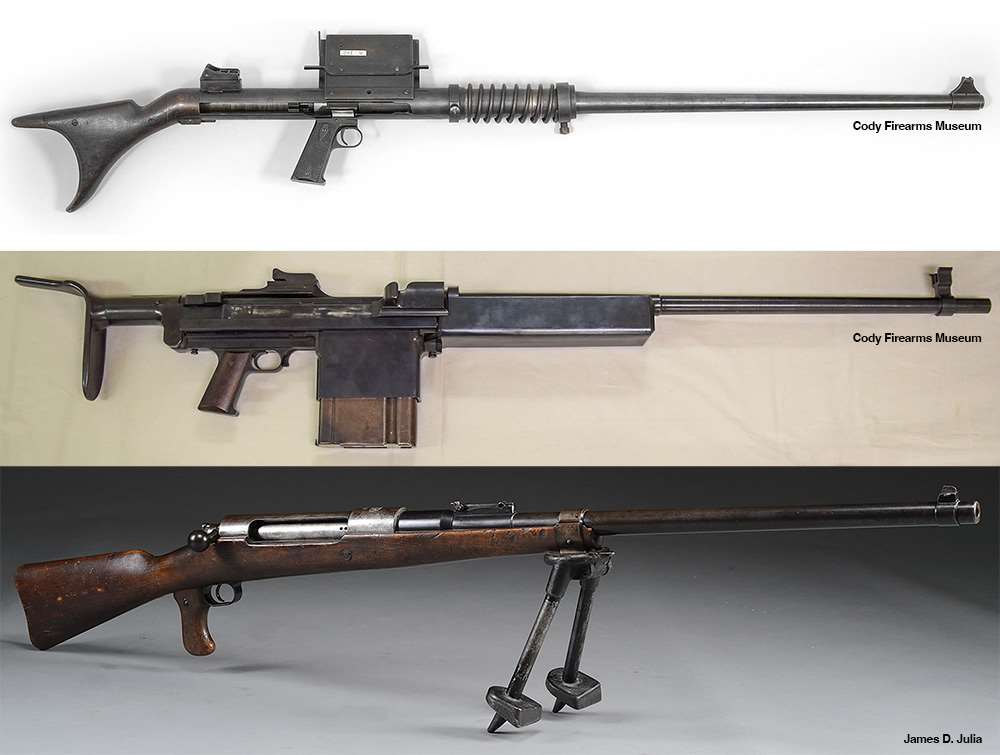
The Winchester Model 1918 .50-caliber High Power Bolt Action Swivel Gun prototype (top) emerged before the end of WWI. During WWII, Winchester developed a prototype .50-caliber semi-automatic rifle based on an enlarged M1 Garand action (middle). American anti-tank rifle development was spurred by the Germany’s deployment of a massive Mauser bolt-action rifle developed to counter Allied tanks introduced during WWI (bottom).
At the dawn of mechanized warfare in WWI, the U.S. Military contended with the reality that infantrymen would need an effective arm to defeat tanks. Their idea? Bring more gun.
The advent of tank warfare during World War I introduced a totally new battlefield threat to the infantryman. The first operational tank was fielded by the British during the Battle of the Somme in September 1916, and the French developed their own tanks in the spring of 1917. Although slow- moving and plagued by mechanical difficulties, the tanks were relatively safe from rifle and machine-gun fire and struck fear into the average German soldier.
But, the Germans soon concluded that a large-bore rifle firing a high-velocity cartridge would be able to penetrate the armor of these early armored vehicles. The famed Mauser Werke at Oberndorf designed a massive, single-shot, bolt-action rifle. The hefty 35.8-pound weight of the rifle was supported by a folding bipod with spiked feet. Overall length was 67 inches (slightly shorter than the height of the average man at the time), and the gun was chambered for a 13 mm cartridge with an 800-grain bullet exiting the muzzle faster than 2,700 fps. It could stop any tank on the battlefield at that time. However, limited numbers of the Mauser 13 mm anti-tank rifles were fielded before the Armistice, and the gun did not have any significant impact during the war.
Early American Anti-Tank Rifles
On Nov. 2, 1918, the U.S. Army evaluated a prototype magazine-fed, bolt-action .50-cal. rifle designed by Winchester, dubbed the “Model 1918 .50-Cal. High-Power Bolt-Action Swivel Gun.” It might have had some application as an anti-tank rifle, but further development was dropped with the ending of the war. The gun was subsequently used primarily to test the early .50-cal. cartridges being developed for the M2 Browning heavy machine gun.
In 1921, the Browning .50-caliber machine gun was adopted, and the Army believed that if an anti-tank rifle should be required, it would meet the need. The U.S. was hardly alone in its lack of a suitable infantry anti-tank weapon during the post-World War I period. However, in the early 1930s, Germany was working on improved tank designs that did not go unnoticed. A number of nations, including England, Japan, Czechoslovakia, Poland, Sweden, Italy, Switzerland, Finland, Denmark and the Soviet Union began development of anti-tank rifles in varying calibers with bolt-action or semi-automatic mechanisms.
The British .55-Caliber Boys Anti-Tank Rifle
In October 1934, the British military assembled a design team under the supervision of Capt. H.C. Boys, assistant superintendent of the design department at the Royal Small Arms Factory, Enfield, tasked with the development of an anti-tank rifle originally dubbed the “Stanchion” gun. Capt. Boys died while the weapon was still being developed, and it was renamed in his honor.
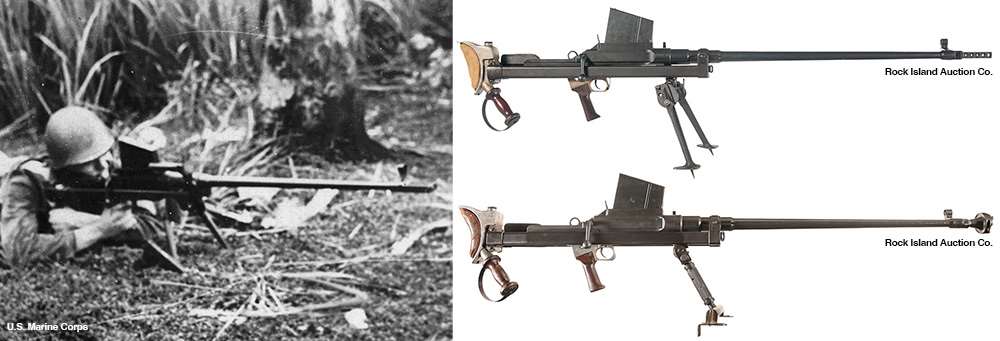
Marine Raiders on Guadalcanal made use of the Mark I* Boys anti-tank rifle (l.). The British-produced Mark I Boys .55-caliber anti-tank rifle (bottom r.) differed slightly from the Boys Mark I* (top r.) as manufactured by the Canadian firm John Inglis and Company, as the Canadian-made variant incorporated a horizontal muzzle brake and a folding bipod.
On Nov. 24, 1937, the “Rifle, Anti-Tank, .55 in. Boys Mark I” was approved for service. The gun utilized a conventional bolt-action mechanism with a five-round detachable box magazine, scaled up to accommodate a .55-caliber cartridge. However, by the time the rifle went into production, it was already essentially obsolete as a “tank killer” due to the tremendous strides made in improving tank armor by the late 1930s.
Nevertheless, the Boys anti-tank rifle was subsequently used with some success against lightly armored Japanese and Italian tanks and fixed positions such as pillboxes and gun emplacements.
Modifying The Browning Machine Gun For Anti-Tank Use
In the late 1930s, with war looming on the horizon, U.S. Army Ordnance embarked on the development of an anti-tank version of the Browning .50-caliber machine gun. This was to be accomplished by equipping the machine gun with a pistol grip, bipod and shoulder stock, which would eliminate the need for the heavy tripod. The gun was designated as an “Anti-Mechanization Weapon.” Since full-automatic fire from a gun of this configuration would be uncontrollable, as well as unnecessary, the experimental .50-caliber anti-tank gun was capable of semi-automatic fire only. Thus, it could be used with short belts of ammunition, which helped to further reduce weight. While designed to be operated by one man, the gun was quite hefty. Even though it could be broken down into two sections, two men were still required to move it any appreciable distance.
Read the entire article on the American Rifleman website.
External Web Site Notice: This page contains information directly presented from an external source. The terms and conditions of this page may not be the same as those of this website. Click here to read the full disclaimer notice for external web sites. Thank you.