“The Men of the Old 15th”
Published: 9 February 2026
By James Lacombe
Special to the Doughboy Foundation website
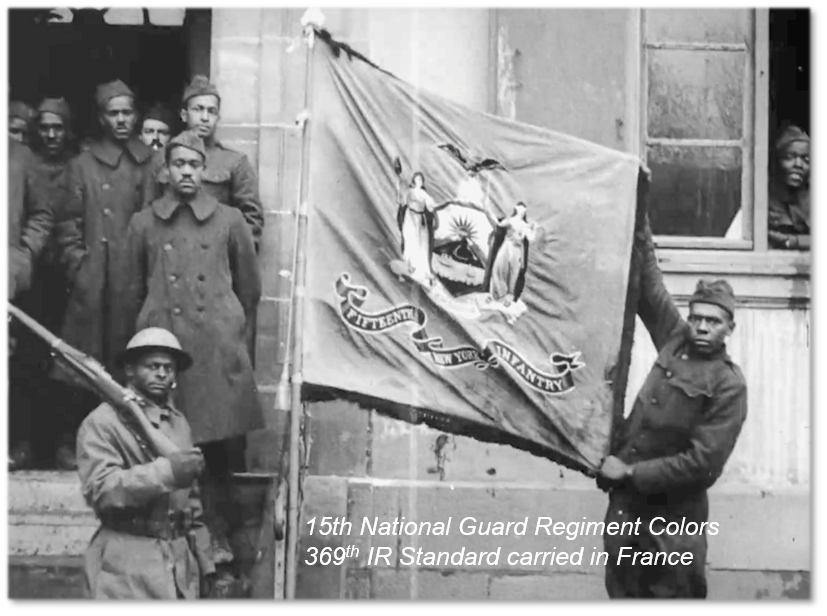
15th National Guard Regiment Colors
Signal Corps Motion Picture Image of the New York National Guard 15th Regiment Flag flying outside 369th Regiment Headquarters in Ungersheim, Alsace, France, Dec. 11, 1918. The men of the 369th identified with this flag of "The Old 15th", as it served as Regimental Colors throughout the 15th/369th Regiment's wartime service.
Based on a modest level of personal research, I’ve concluded, with reasonable confidence, that the title of this article best captures what the men of the 15th (AKA 369th) Infantry Regiment referred to themselves as during the First World War. This includes during the Regiment’s time in France, from late 1917 to early 1919.
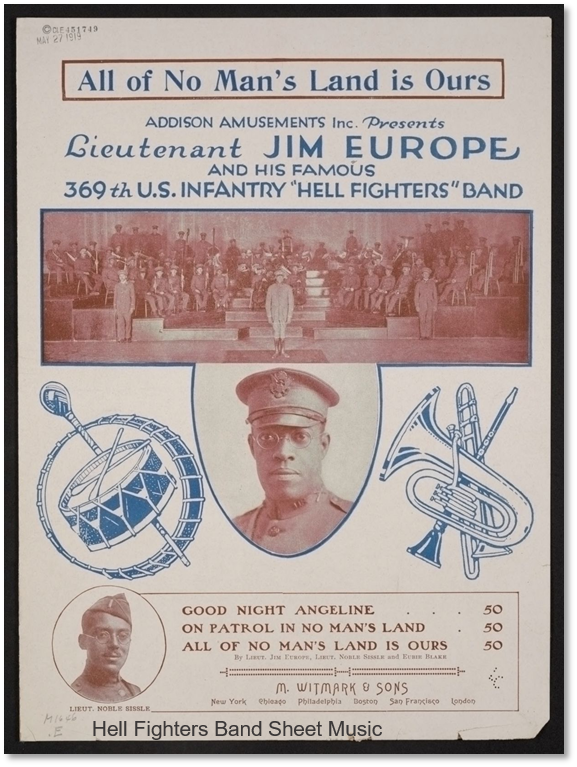
Sheet Music Cover “All of No Man’s Land is Ours”, Lt. Jim Europe and his Famous 369th Infantry “Hell Fighters” Band, Addison Amusements Inc., May 27, 1919.
I’ve also concluded that, following the Armistice, and most likely shortly after the return of the 369th to New York, the men of the Regiment embraced the title “Harlem Hellfighters”, with James Reese Europe, leader of the famous 369th Regiment Band, even adopting the moniker for the name of his post-war band. [1] In retrospect, the reasons for this are certainly understandable. “Harlem Hellfighters” was (and still is) both a wonderful alliterative and a feisty title for a fighting unit, certain to engender self-pride and esprit de corps amongst its members.
Additionally, at least for Reese Europe, use of the name constituted smart “marketing”, considering the public’s enthusiasm for this martial title and the feel-good (and conscience easing) wartime narrative behind it that fit so well into the larger national patriotic narrative being broadcast at that time. Newspaper articles [2] [3] [4] describing the fearless and fearsome exploits of the Harlem Hellfighters (especially those of Privates Johnson and Roberts) were eagerly consumed by readers, resulting in well-deserved widespread recognition of the Regiment and praise for (race related struggles aside) its wartime accomplishments and important contribution to final victory over the Axis powers.
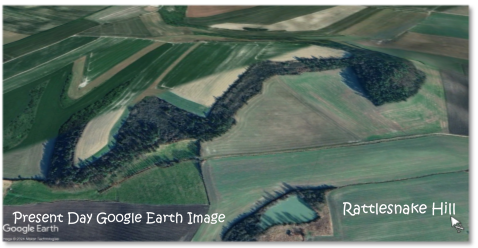
But, as suggested above, I have not come across a single reference to the term Hellfighter or Hell Fighter (as in either “Hayward’s Hellfighters” or “Harlem Hellfighters”) prior to the return of the 369th to America. (Arthur Little mentions the term in his post-war history of the Regiment, but only in his introduction.) [5] I also have yet to read an attributable citation, with relevant details, for that Prussian officer’s famous reported characterization of the men of the 369th as “Hollenkampfer”, not to mention an in-theater acknowledgement of its English translation as a coveted badge of honor. Also, as an interesting side note, I have been unable to find any wartime references to the men of the 369th as either “Rattlers” or “Black Rattlers”, nicknames individuals such as Sammons and Morrow, in their sweeping tome on the Regiment [6], suggest existed at that time. Jamieson et al., in their post-war book dealing with the black soldiers of the AEF, report such a fighting nickname arising after the taking of “Rattlesnake Hill”, south of Sechault in Sept., 1918 during the Meuse Argonne Offensive, but offer no specific citation or other evidence to support the claim. [7]
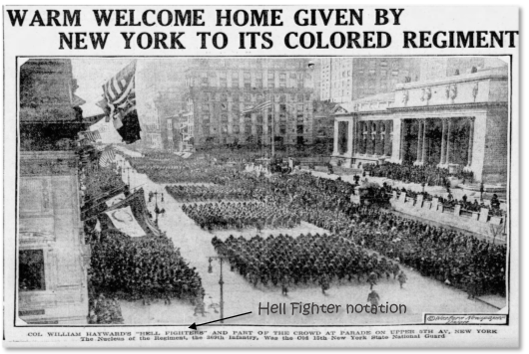
“Warm Welcome Home Given By New York To Its Colored Regiment”, “Hayward’s “Hell Fighters” phrase included in article photo caption of Regiment marching up 5th Avenue., Boston Globe, Boston, MA, Feb. 18, 1919.
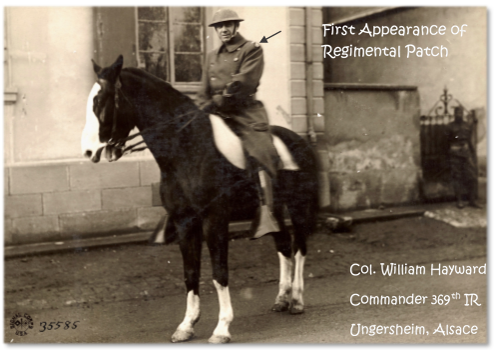
It is well known that the image of a coiled serpent/rattlesnake was chosen by the 369th Regiment Commander, Col. William Hayward, in April, 1918 to be the Regiment’s insignia; Hayward did this when pressed by the French for a distinguishing symbol to mark on his regiment’s wagons. [8] There is no evidence to suggest that this decision was driven by anything other than the appeal of the symbol’s historical “don’t tread on me” message, however. A regimental patch with the coiled snake symbol does appear, if only on the shoulder of Col. Hayward, in photos and motion picture reel images starting around mid-December, 1918. Between that time and the Regiment’s return to the U.S. in early Feb., 1919, photographic evidence shows the patch, with its serpent symbol, spreading to the shoulders of all the Regiment’s officers, regimental band members and decorated soldiers, but not to the broader rank and file. To my knowledge though, no “Rattler” notation accompanies any related photograph or newsreel.
Today, the soldiers of the 369th Sustainment Brigade, the namesake descendant organization of the 369th Infantry Regiment, refer to themselves as the “Hellfighters”, and good for them! They certainly have the deserved permission and right to do so. But as Army National Guard military historian, Joseph Seymour posits: “The case of the Harlem Hellfighters is a particularly interesting claim,”… “It was not what they called themselves. It is what the enemy called them.” [9]
My sole concern, and reason for writing this article, is that much of the public may be inferring otherwise. Many published articles simply state that the men of the 369th referred to themselves as the Harlem Hellfighters, without qualification, which, even if done unintentionally, implies that the men ascribed the term to themselves during the war. That doesn’t appear to have been the case. Apparently, the phrase “Harlem Hellfighters” was more of a press-inspired “nom d’après-guerre” than a true “nom de guerre”.
I wish the reader to note that I raise this topic to simply clarify a historical point that warrants accurate public accounting. The article is in no way intended to denigrate the memory of the soldiers of the 369th and their remarkable accomplishments leading up to and during America’s participation in the Great War. Quite the contrary, it is written out of respect for the Men of the Old 15th, to help set the record straight (I like to think, on their behalf).
Respectfully,
Jim Lacombe
Grandson of:
Sergeant James Cox
Company L, 308th Infantry Regiment
77th Division, AEF 1917-1919
[1] Sheet Music Cover “All of No Man’s Land is Ours”, Lt. Jim Europe and his Famous 369th Infantry “Hell Fighters” Band, Addison Amusements Inc., May 27, 1919.
[2] “Old 15th Back in the United States”, Front Page Headline, The New York Age, NY, NY, Feb. 15, 1919.
[3] “New York’s “Hell-Fighters March up the Avenue”, Photo Headline, New York Tribune, Feb. 18, 1919, Pg. 9.
[4] “Warm Welcome Home Given By New York To Its Colored Regiment”, “Hayward’s “Hell Fighters” phrase included in article photo caption of Regiment marching up 5th Avenue., Boston Globe, Boston, MA, Feb. 18, 1919.
[5] Arthur W. Little, “From Harlem To The Rhine, The Story of New York’s Colored Volunteers”, Covici-Friede Publishers, NY, 1920, Introduction.
[6] Sammons, Jeffrey T. and John H. Morrow, Jr., “Harlem’s Rattlers and The Great War, The Undaunted 369th Regiment and The African American Quest for Equality”, University Press of Kansas, 2014.
[7] Jamieson, Sgt. John A., et al., “Complete History of the Colored Soldiers in the World War”, Bennett & Churchill, NY, NY, 1919, Pgs. 20, 37.
[8] “Memorandum of on Chronology and Statistics”, Headquarters Division, N.Y.G., July 1, 1920, Report of the Activities In the World War of 369th United States Infantry (15th New York), Section dealing with the Regimental Insignia, Pg. 38.
[9] Durr, Eric, “After 100 Years, the Harlem Hellfighters Nickname is Finally Official”, New York National Guard, U.S. Army Website article dated Feb. 1, 2021. https://www.army.mil/article/242877/after_100_years_the_harlem_hellfighters_nickname_is_finally_official
External Web Site Notice: This page contains information directly presented from an external source. The terms and conditions of this page may not be the same as those of this website. Click here to read the full disclaimer notice for external web sites. Thank you.