Selling liberty: The propaganda campaign that funded WWI
Published: 5 February 2026
By Alexandra Vollman
via the Spirit & Sword Substack website
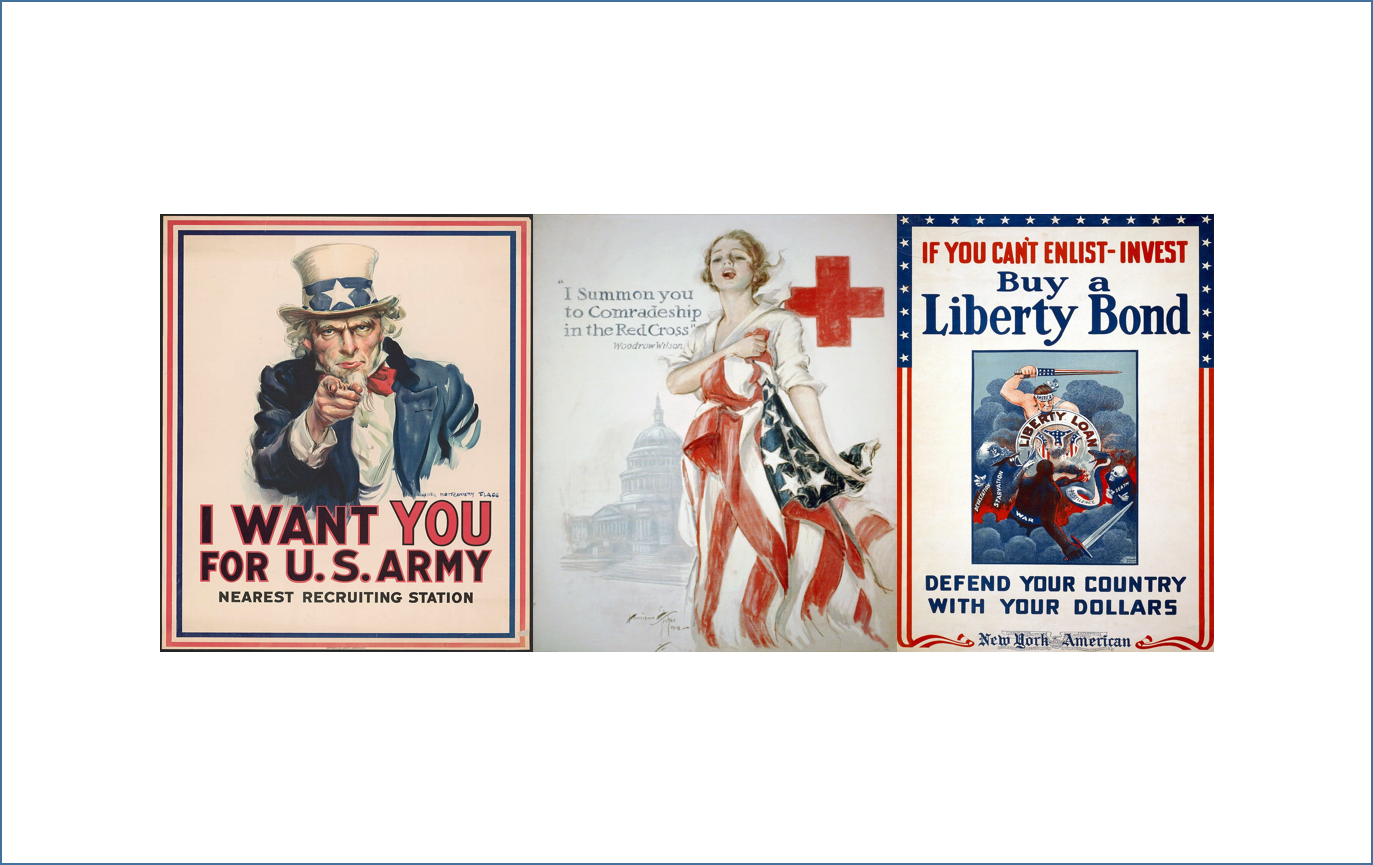
Prophaganda posters framed
Posters created under the CPI to influence public opinion and support for WWI.
The tactics conceived by President Wilson’s Committee on Public Information became the blueprint for engineering consensus in wartime and beyond.
“Propaganda does not deceive people; it merely helps them to deceive themselves.”
— Eric Hoffer
On July 14, 1918, William McCormick Blair addressed a crowd of moviegoers at one of Chicago’s many picture houses. He spoke passionately of the United States’ and France’s devotion to freedom and the reciprocity between the two “unconquered and unconquerable” nations.
A concerned citizen, Blair felt the weight of the moment.
Until the year prior, the United States had maintained its isolationist policy as Russia and France battled invading German troops. The 1915 sinking of British luxury ocean liner the Lusitania, which killed over 120 Americans, and the surfacing of the Zimmerman telegram, revealing an attempt by Germany to ally with Mexico, however, led President Woodrow Wilson to reconsider his position.
In April 1917, the U.S. joined the Allied Powers — which also included Great Britain, Italy and Japan — in their fight for sovereignty.
As Blair stood before the throngs of people, the war was still fresh on Americans’ minds, the date relevant.
“Liberty has two birthdays,” Blair declared, “one in the new world and one in the old. One is marked by the anniversary of our Declaration of Independence on July 4, 1776; it is the birthday of a nation in the new western world, dedicated to the proposition that all men are created free and equal; its cradle was Independence Hall in Philadelphia. …”
“The second cradle of Liberty was amid the ruins of the Bastille in Paris on July 14, 1789,” he continued. “The people of Paris destroyed this great Mediaeval prison, the emblem to them of tyranny and oppression and autocratic government. They lighted the torch of liberty at its smoldering ruins and sent their armies forth from the first great European republic …”
“These two great republics are children of the same spirit,” Blair added.
In the four minutes it took the projectionist to change the reels, Blair had delivered to a captive audience of Chicagoans an impassioned and impromptu speech.
Or, at least that’s how it appeared.
In 1916, President Wilson won re-election largely for his commitment to keeping the U.S. out of World War I — diverging from his opponents Roosevelt and Taft in a campaign characterized by the slogan “He kept us out of war.” Even as late as January 1917, Wilson continued to advocate for neutrality — despite pleas from France and its allies — delivering his now famous “Peace without Victory” speech to the U.S. Senate.
“I am proposing that all nations henceforth avoid entangling alliances which would draw them into competitions of power, catch them in a net of intrigue and selfish rivalry, and disturb their own affairs with influences intruded from without. There is no entangling alliance in a concert of power. When all unite to act in the same sense and with the same purpose, all act in the common interest and are free to live their own lives under a common protection.”
—President Woodrow Wilson, “Peace without Victory” speech
Thus when Wilson reversed course two months later, in April 1917, to declare war on Germany – most Americans opposed the move.
Anti-war sentiment remained pervasive, impeding Wilson’s ability to fund the U.S.’s war effort. Thus the administration needed a way to bring the public onboard. The way to do it, Wilson thought, was to create a unified public narrative as to why the war mattered.
Within a week of Congress declaring war, Wilson signed an executive order creating the Committee on Public Information (CPI), a temporary independent federal agency focused on increasing public support for the war. To lead it, Wilson enlisted American investigative journalist George Creel.
But if the CPI’s efforts were to be effective, they had to appear organic.
Standing before the crowd of moviegoers on July 14, 1918 – France’s Fête Nationale, commemorating the storming of the Bastille – Blair wasn’t simply a patriotic American stirred by the occasion. The prominent Chicago banker and civic leader was also the National Director of the CPI-led initiative the Four-Minute Men (named for the length of time it took to change a film reel), and he was there to rally the cause.
Read the entire article on the Spirit & Sword website.
External Web Site Notice: This page contains information directly presented from an external source. The terms and conditions of this page may not be the same as those of this website. Click here to read the full disclaimer notice for external web sites. Thank you.