“On the Front, Somewhere in France, October 6, 1918.”
Published: 19 February 2026
By Cianna Lee
Special to the Doughboy Foundation website
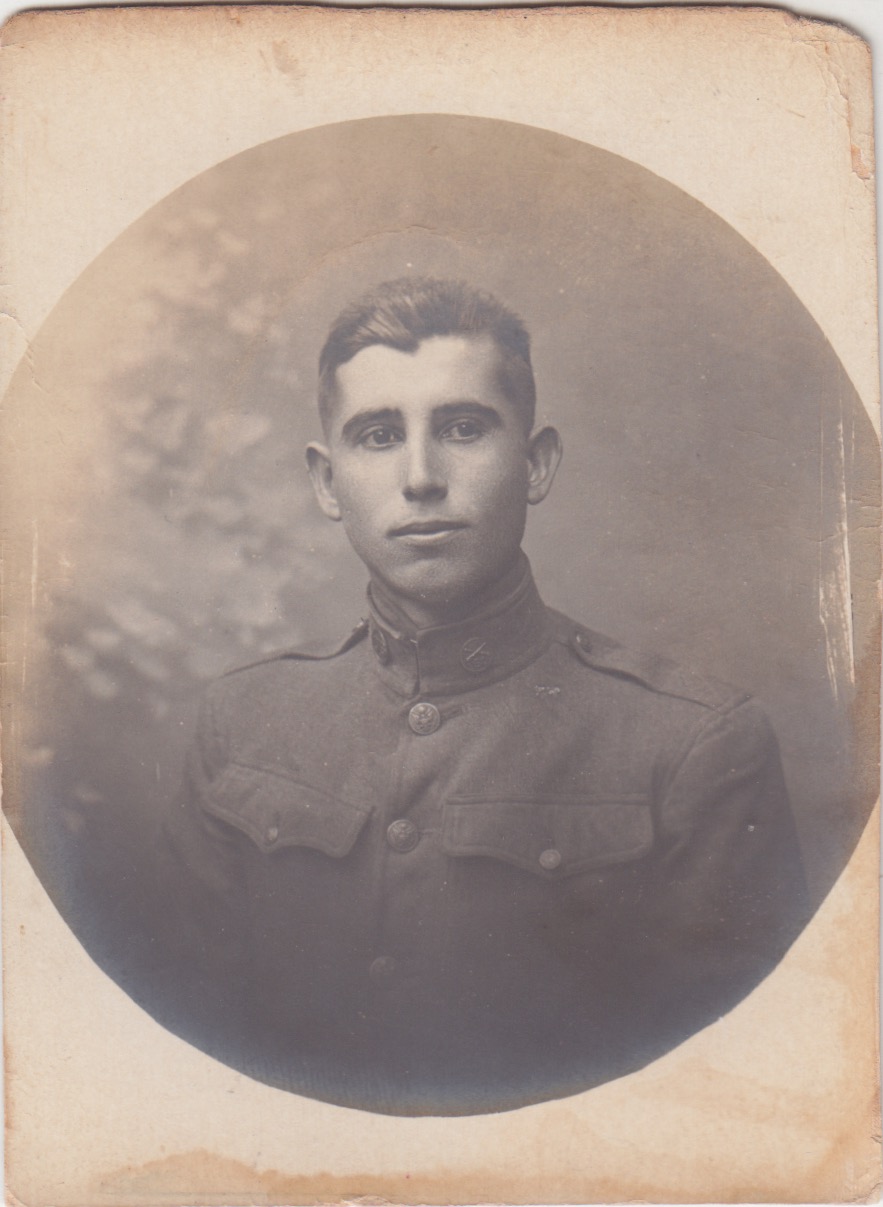
Image 1
This postcard came to us from an unknown sender, one of two, with no note about who the person in both postcards could have been. The envelope had “Unknown Soldier” written across it. The first showed a person as an adolescent, with nothing written on it. The second shows the same person in uniform with infantry buttons, against a painted vine background, clearly a formal portrait taken in a studio. The printed section of the postcard is in French, so likely someone who was in the A.E.F. and made it to France. The only clue on the postcard was a name and an address – “Mrs. C. K. Russ, 433 S. Scott St, New Orleans, LA.”
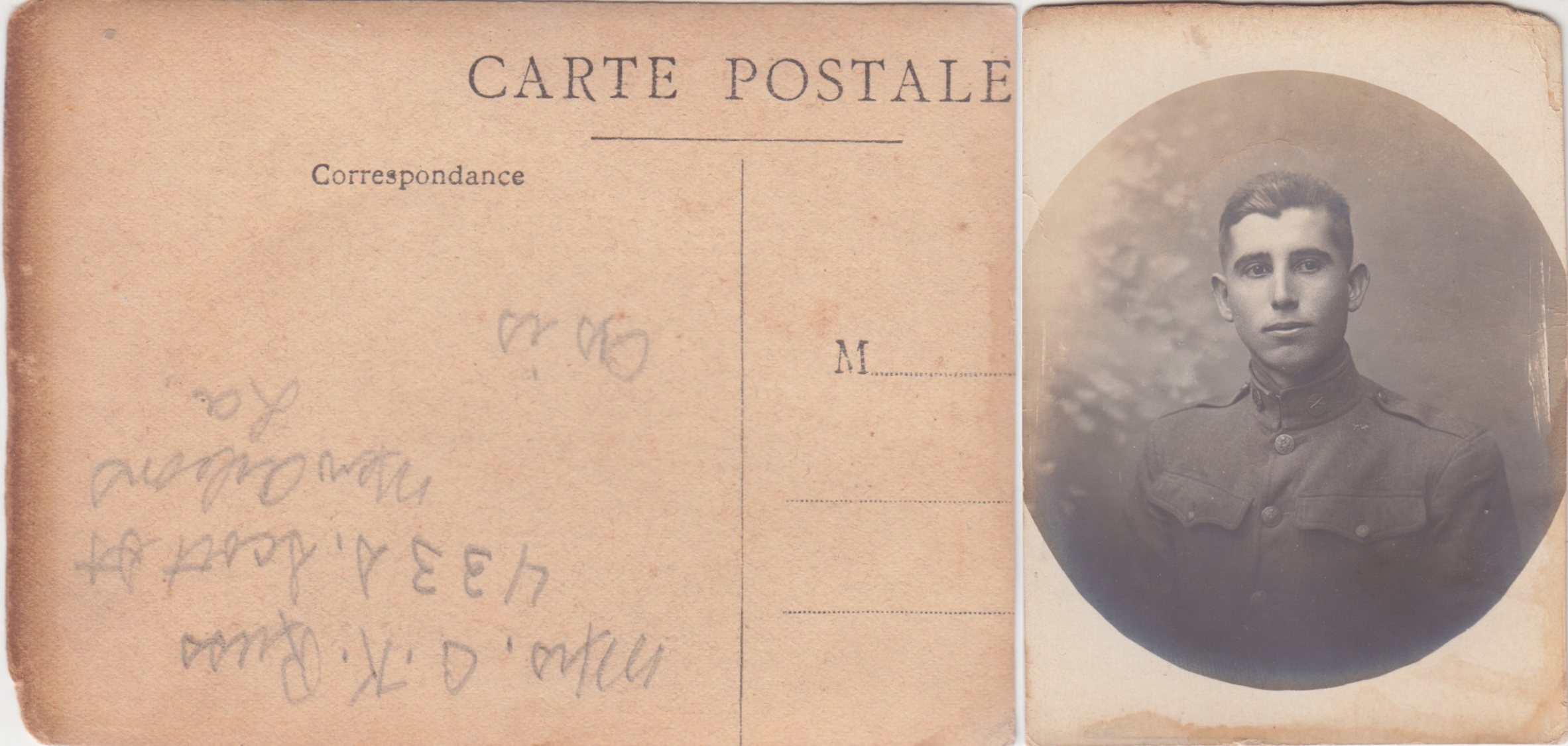
Front and back of the mystery postcard from World War I.
From there, there were two routes: try to find a soldier that enlisted from that address, or try to find the person who the postcard was addressed to. As enlisted troops and their addresses were (often) printed in the newspaper, I tried that first. Robert E. Lee Walker came straight up, he lived at the right address, it was possible that he was sending this picture from France to his neighbor or sister with who was married, however he signed up for the military as a farrier attached to a medical unit, rather than in the infantry.
Going the other route, I tried to find Mrs. C. K. Russ, and with a few searches of records on Ancestry and local newspapers, I came up with Mrs. Christy K. Russ (maiden name Sarah Toomer).
Christy and Sarah had two male children, both of which had enlisted in the military during the war. Christy Jr. (1894-1936) and George (1895-1960). George enlisted as part of a medical unit, but Christy Jr. enlisted as part of the Artillery, fitting with the buttons on the man’s portrait.
When going through Christy’s records, I looked for any indication to prove completely that the portrait was him, and I finally came across it. There was a photograph attached to his military discharge papers, matching the features of the person in the portrait.
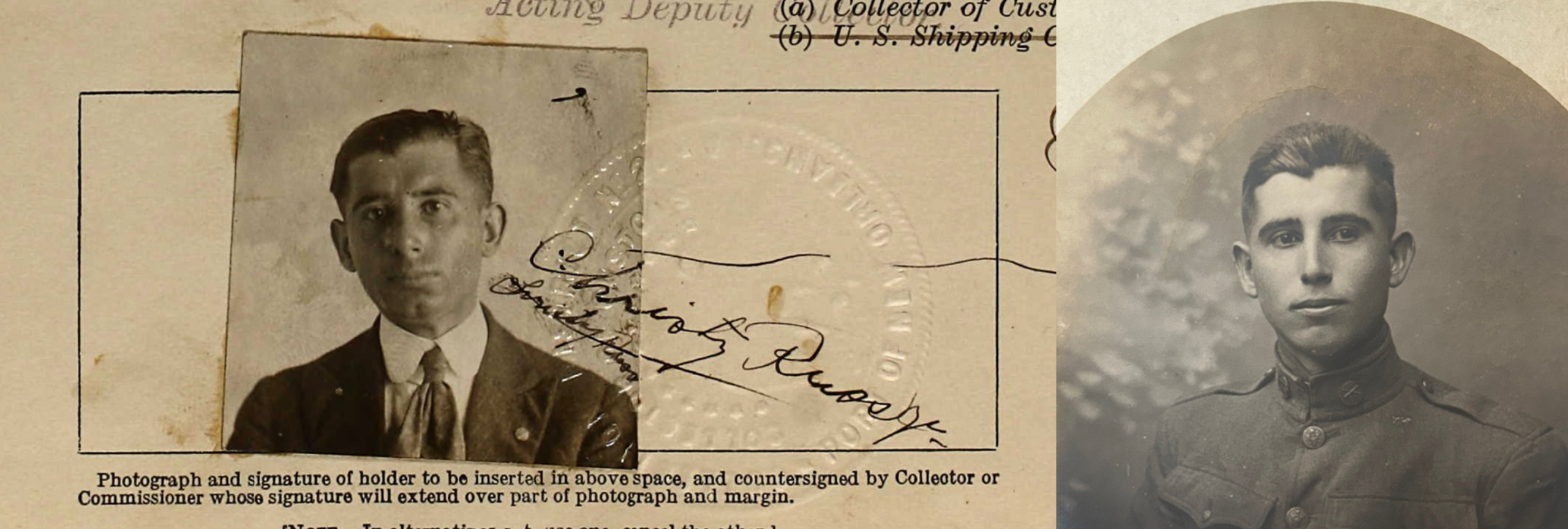
(left) Photo attached to military discharge paperwork, matching the postcard portrait (right) confirms the identity.
Christy K. Russ Jr. was born August 7th, 1894, in Pearlington, Mississippi, to Christy Koch Russ (a grocer) and Sarah Francis Toomer. He had a brother, George, and two sisters, Nettie and Minnie.
In February 1915, Christy Jr. appeared in the newspaper of his hometown with a letter he wrote from England being featured. He wrote that he was working on a cattleship and even from the shore, he could tell the state that Liverpool was in. He wrote to his uncle, “War is Hell’ and Hell is every place here.” He also talked about his wish to get home as soon as possible and he’s seen enough war for a lifetime.
Just after his 21st birthday, in September of 1915, he apparently had a change of heart and enlisted in the military, going through training at Columbus Barracks in Ohio. A month into this training, his father would pass away at 55.
In October, he wrote to his hometown paper about his experiences:
Gentlemen:
I am glad to say I am receiving my home paper daily. Through a local news agent here at Columbus Barracks, Ohio. Again I appreciate The News as to get all the up to date news from all over the country. I am a lad from Hattiesburg, Miss., now in the service of the U.S. Army, in the coost [sic] artillery branch, at the Columbus Barracks, Ohio. I joined the Army the 20th day of September, so I will leave for my post in a short while, either New York or out at California.
Hoping the market price for cotton this fall in the vicinity of Hattiesburg increases steadily, I remain,
Yours Sincerely,
Christy K Russ, Jr.
22 Rct. Co., Columbus B[arrac]ks, Ohio.
Home address, 211 Elizabeth Ave., Hattiesburg, Miss.
Once he finished training, he was assigned to Battery A of the 42nd Coast Artillery (Railway) Regiment, which supported the French army on the coasts of France in 1918 and 1919. Two letters of his were published in his local papers about his experiences in France in 1918, one a few months after arriving, and another one year in.
The first only has sections that were featured, saying France is a fine country, the French have been kind to him. The weather has been good, and there is good local hunting. The second letter says more about his service, dated October 6th, 1918.
“On the Front, Somewhere in France,
October 6, 1918.
Editor Hattiesburg American:
I will endeavor to write a few lines to the American this evening while we boys have a few hours to ourselves. We are still doing wonderful work here in this sector. Everything is going along fine, as well as could be expected. We have the Boche on the move again towards the Rhine. Our people at home can picture them as a tribe of Gypsies being driven out of some desirable territory. He is certainly getting his share of punishment for the enormous crimes he has committed in the beginning and conduct of this great world war, which is being waged on our part for Liberty. I have been in France over a year now; we came over with the first 30,000 and have certainly seen our share of adventure since then.
This section of Europe is beautiful. The valleys and the hills are picturesque, especially from a distance. Another feature about this part of the country is the old prehistoric statues and buildings that still are left, and not destroyed by the Boche. Fruit and vegetation are abundant here as this is a very rich and industrious part of Europe.
I have received several copies of the American lately and it sure does a fellow a lot of good to read a real American patriotic paper from home.
I want to thank the good, patriotic people of Hattiesburg in their War Savings Stamps and Liberty Bonds campaigns in which they have “gone over the top,” The people at home are certainly doing their bit for us over here.
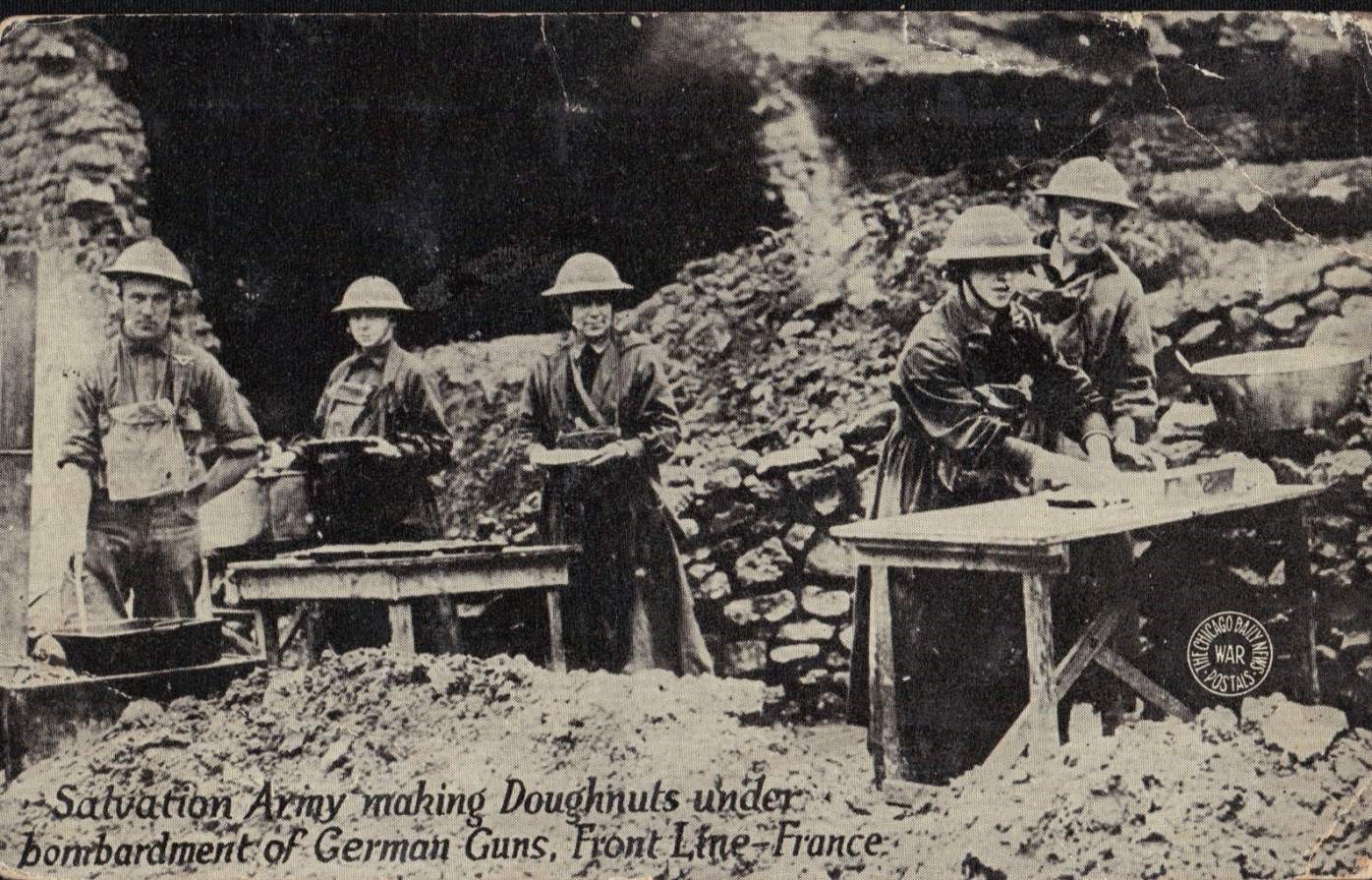
Most everybody has a good word to say for our Y.M.C.A. and we certainly appreciate the organizations in the field and especially the Salvation Army and Knights of Columbus. We boys wouldn’t know what to do without them. They follow us everywhere through sunshine and rain, through battle smoke and gas, and though we sometimes say hard words, it comes along just the same and when the fight comes on they are always on hand with coffee, doughnuts and cigarettes to brace us boys up.
There is one thing that we regret – that there are too many canteens in Paris and not enough for the hundreds of thousands of boys in the field. Here we can buy anything in the stores almost as cheap as in the canteens, while far out in the country we sometimes can’t buy at all as the supplies get low and there are no stores nearby. Few of us boys ever see Paris; it is mere hearsay, but we are not knocking.
With best regards,
Yours sincerely,
PVT. Christy K. Russ Jr.
Battery A, 42nd Artillery, Coast Artillery Corps, A.E.F.
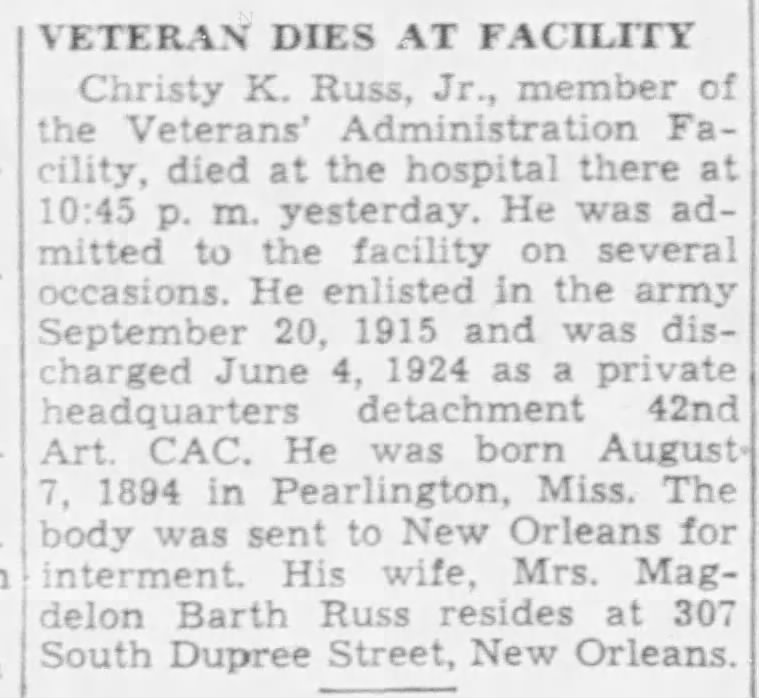
After seeing some fighting, he was transferred to the 42nd Coast Artillery Headquarters, where he remained as a Private for the rest of the war. When the war ended, he was moved to the Army Reserve, and headed to New Orleans, where his family had relocated. There he met and married Magdalene Barth (1904-1975) in August of 1929. The two remained together for several years before separating, Christy moving back to his hometown, and Magdalene staying in New Orleans. Christy’s health would continue to deteriorate until 1936, when he died in his town’s Veterans Association medical facility.
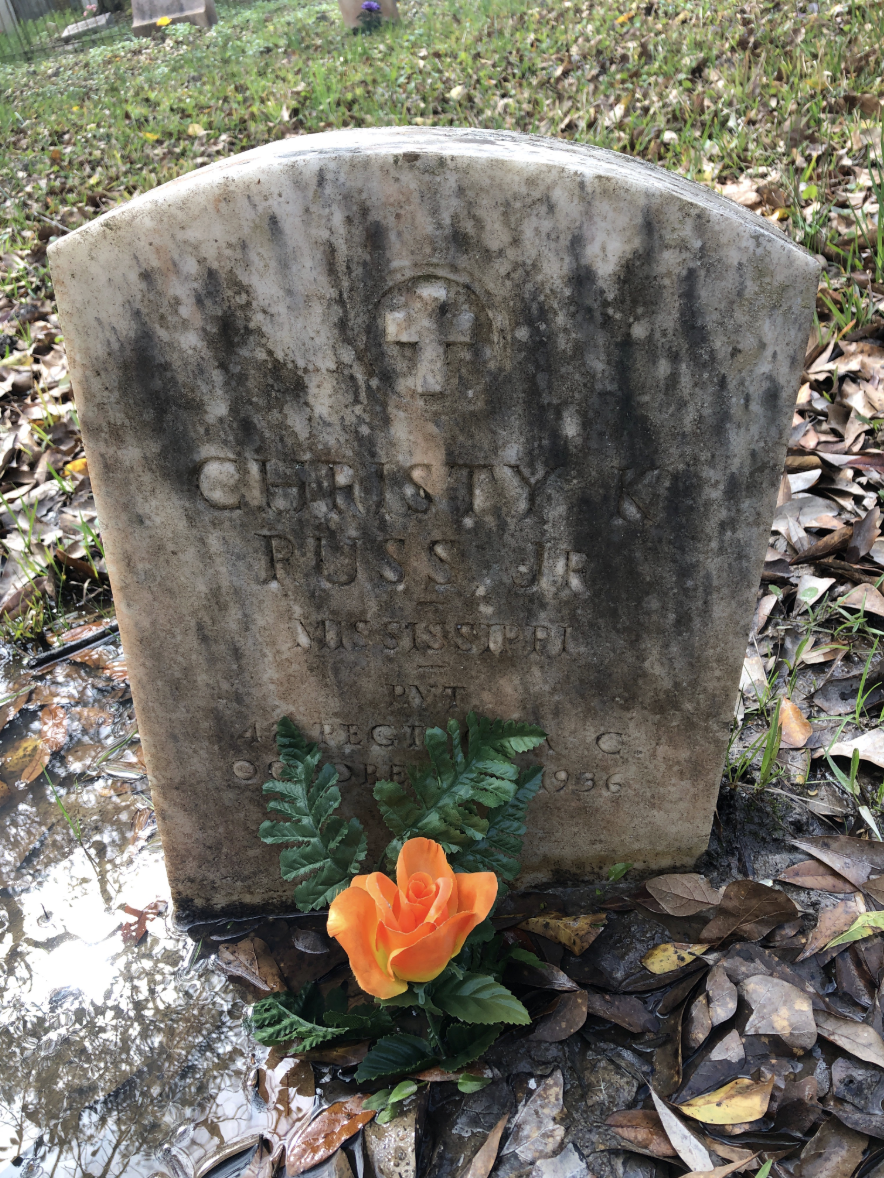
Christy would be buried in his local cemetery, Pearlington Cemetery, with his wife as the only listed surviving relative.
Cianna Lee is a Senior at Bennington College in Vermont.