How World War I Service Shaped Modern Military Civil Rights Laws
Published: 20 February 2026
Special to the Doughboy Foundation website
Draftees
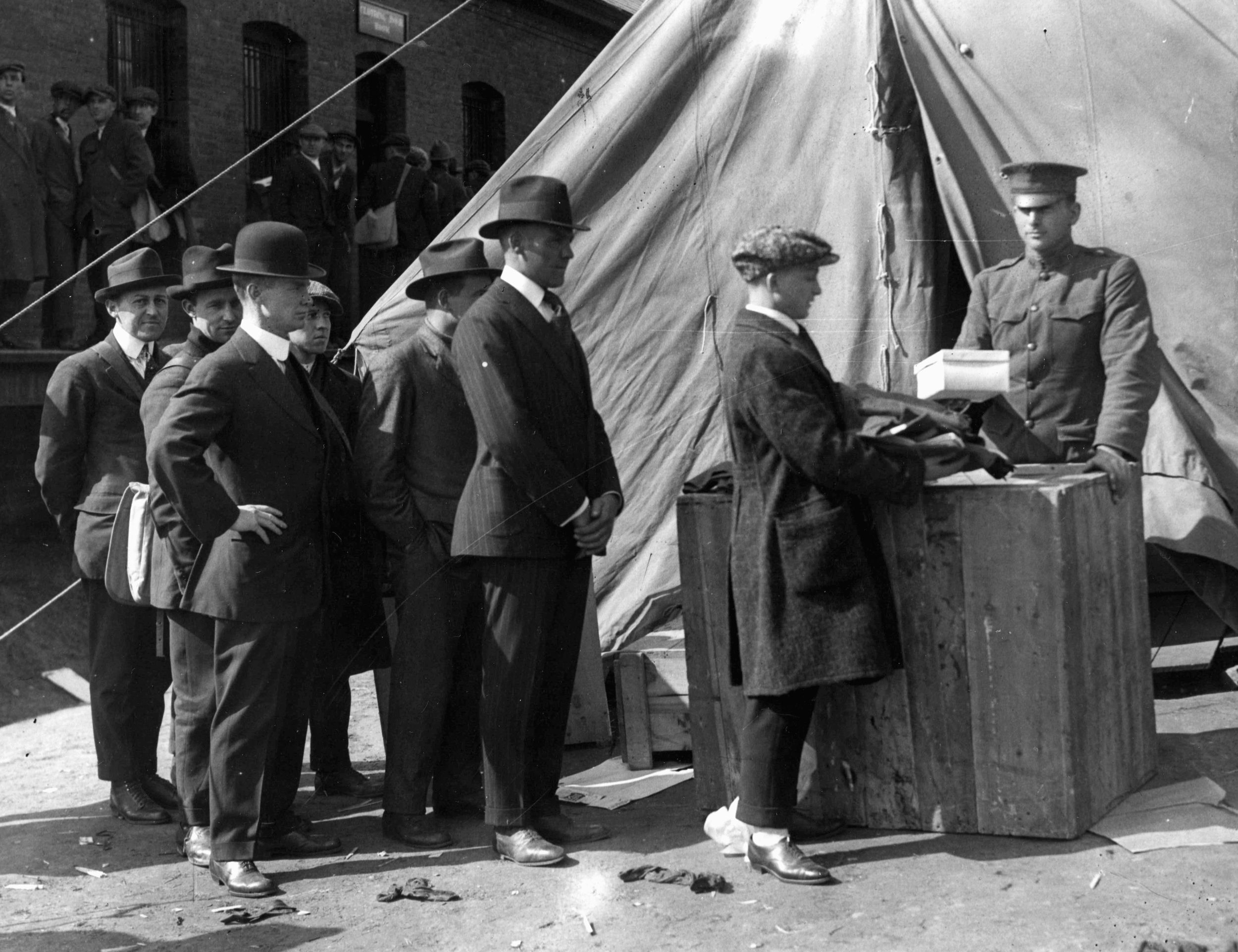
American draftees report for duty at Fort Slocum, Long Island, in June 1917. The rapid expansion of the U.S. armed forces, with millions of civilians called into military service, exposed a critical weakness in American civil law.
When the United States entered World War I in 1917, it did more than mobilize an army. It mobilized a nation’s legal system for a challenge it had never faced before. Millions of Americans left civilian life almost overnight, stepping into military service while their financial obligations, property interests, and legal disputes remained behind at home. Courts continued to operate. Creditors continued to collect. Landlords continued to evict. The law, however, had no meaningful mechanism to account for wartime absence.
This collision between military duty and civilian responsibility exposed a critical weakness in American civil law. Wartime service did not pause civil obligations, and service members bore the consequences. The resulting legal strain would permanently reshape how the United States understands civil rights in times of war.
Civil Law in a Nation Unprepared for Mass Mobilization
Before World War I, American civil courts treated military service as largely irrelevant to legal proceedings. Enlistment did not excuse missed court appearances, unpaid debts, or breached contracts. For most of the nation’s history, military service had been limited in scale and duration, affecting relatively small portions of the population. The legal system had little incentive to adapt.
World War I changed that calculus almost immediately. Conscription and voluntary enlistment removed millions of men from civilian life. Many left farms untended, businesses unmanaged, and families dependent on limited wartime wages. Without federal safeguards, deployed soldiers faced lawsuits they could not contest, judgments they could not prevent, and foreclosures they could not challenge.
Wartime service exposed a reality lawmakers could no longer ignore. Military duty did not eliminate civil obligations, but it severely limited a service member’s ability to meet them. The absence of legal protection threatened not only individual soldiers, but also the stability of the home front itself.
World War I and the Birth of Federal Servicemember Protections
As reports of legal and financial hardship mounted, Congress recognized that wartime service required a legal response. During World War I, Congress passed the Soldiers’ and Sailors’ Civil Relief Act of 1918 to protect servicemembers from civil legal disadvantages arising from wartime service. Although that specific act expired after the war, it established an important precedent that informed the later 1940 Soldiers’ and Sailors’ Civil Relief Act and ultimately the modern Servicemembers Civil Relief Act.
The Act was not designed to erase obligations. Instead, it acknowledged the practical limitations imposed by military service. Courts were authorized to delay proceedings. Creditors were restrained from enforcing certain penalties. The law sought balance rather than absolution, preserving legal fairness without undermining contractual integrity.
This legislation reflected a broader wartime understanding. National defense depended not only on soldiers abroad, but on economic and social stability at home. If service members returned from war to ruined finances and lost property, the cost of service would extend far beyond the battlefield.
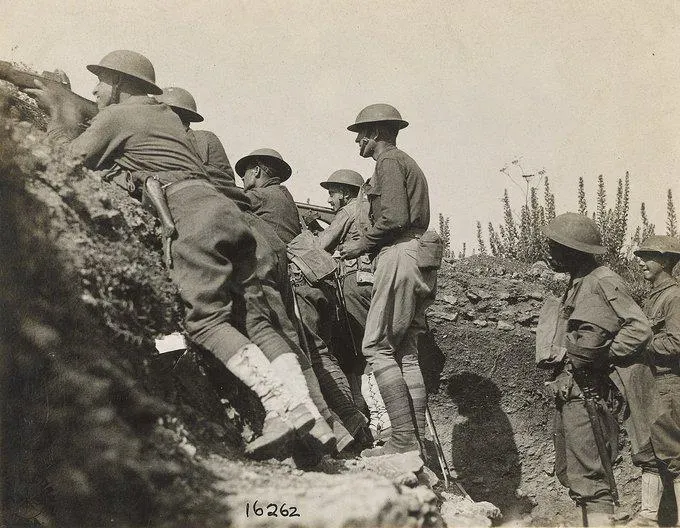
Doughboys of Company B, 328th Infantry Regiment in a trench in France during World War I.
Legal Protections as Instruments of Wartime Stability
The Soldiers’ and Sailors’ Civil Relief Act was as much a tool of national stability as it was an act of individual protection. Lawmakers understood that morale suffered when families at home faced eviction or financial collapse. Protecting civil rights during wartime became inseparable from maintaining public confidence in the war effort.
Early court decisions reinforced this principle. Judges increasingly recognized that military service created unavoidable legal disadvantages. Relief provisions were applied not as privileges, but as necessary adjustments to preserve fairness under extraordinary conditions.
This marked a shift in American legal thinking. Wartime service was no longer viewed as a personal choice with private consequences. It was a public duty deserving of public accommodation.
From Emergency Measures to Enduring Legal Principles
Following the Armistice, policymakers faced a critical question. Were these protections merely temporary wartime measures, or did they reveal deeper structural flaws in civil law? Subsequent conflicts answered that question decisively.
World War II, Korea, and Vietnam each reintroduced large-scale deployment and the same legal vulnerabilities. Rather than abandon wartime protections after each conflict, Congress refined and expanded them. The temporary relief of World War I evolved into a recurring legislative framework grounded in precedent.
Each war reinforced the same lesson. Civil law must account for military service not as an exception, but as a recurring feature of modern governance.
Twentieth-Century Wars and the Refinement of Civil Rights Protections
Later conflicts strengthened federal involvement in military civil rights. Courts were granted clearer guidance. Protections were standardized across jurisdictions. Judicial discretion gave way to enforceable legal standards.
This period saw growing recognition that civil liberties could be compromised indirectly through procedural mechanisms. Default judgments, for example, could deprive service members of property without ever reaching the merits of a case. Wartime reforms increasingly focused on preventing such outcomes before they occurred.
The law’s focus shifted from reactive relief to proactive protection, embedding military considerations into routine civil processes.
Wartime Foundations of Modern Military Civil Rights Law
By the late twentieth century, these accumulated reforms culminated in a modern legal framework that treats military service as a legally relevant condition. Civil rights protections for service members are no longer framed as wartime charity, but as enforceable federal safeguards grounded in constitutional fairness.
Modern military civil rights law reflects its wartime origins. It acknowledges that service members remain citizens first, even while fulfilling national defense obligations. Courts are now required to consider how military duty affects participation in civil proceedings, access to justice, and procedural fairness.
The transformation that began during World War I continues to shape legal interpretation today.
Why Military Status Verification Became Essential
One of the most enduring lessons of wartime legal reform was the need for accuracy. Courts cannot protect service members if they do not know who is serving. During World War I, inconsistent recognition of military status led to uneven application of legal protections.
Over time, military status verification emerged as a foundational safeguard. Verifying active service ensures that courts do not unknowingly issue judgments against individuals unable to defend themselves due to wartime obligations. This procedural step, rooted in wartime necessity, now serves as a gatekeeper for civil fairness.
Its purpose is not delay for its own sake, but the prevention of irreversible legal harm.
Balancing National Defense and Civil Rights Across Generations
Wartime legal reforms reflect a uniquely American balancing act. The nation demands service in moments of crisis, yet remains committed to civil liberties even under strain. Military civil rights laws exist within this tension, shaped by the realities of war but guided by constitutional values.
Protections extend beyond individual service members to military families, whose stability directly affects readiness and reintegration. Wartime legislation thus became part of a broader civil rights evolution, linking military service to citizenship rather than separating the two.
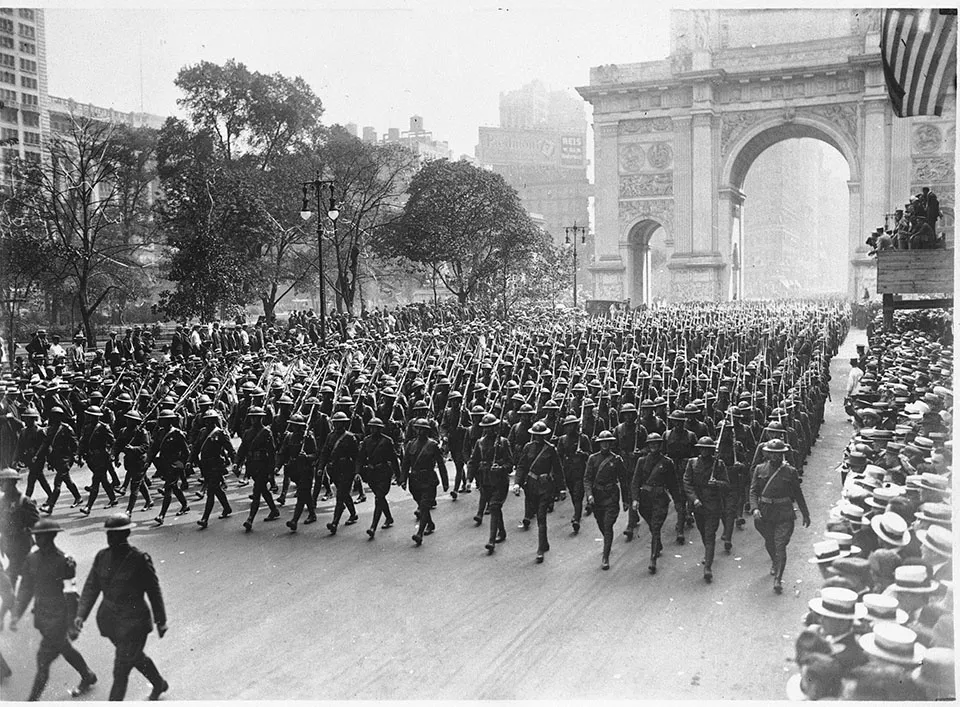
US Marines parade down Fifth Avenue in New York City on September, 1919, almost a year after the World War I ended.
Conclusion
World War I marked a turning point in American legal history. It revealed the inadequacy of civil law in the face of mass mobilization and forced the nation to reconcile military duty with civil justice. The protections born of wartime necessity evolved into enduring legal principles that continue to define military civil rights today.
Modern safeguards are not anomalies. They are the legacy of wartime service, shaped by conflict, refined through experience, and preserved to ensure that service to the nation does not come at the cost of civil fairness.
External Web Site Notice: This page contains information directly presented from an external source. The terms and conditions of this page may not be the same as those of this website. Click here to read the full disclaimer notice for external web sites. Thank you.