How Soldiers at Fort Riley Helped Spread the Spanish Flu Pandemic During WWI
Published: 19 February 2026
By Allen Frazier
via the Military.com website
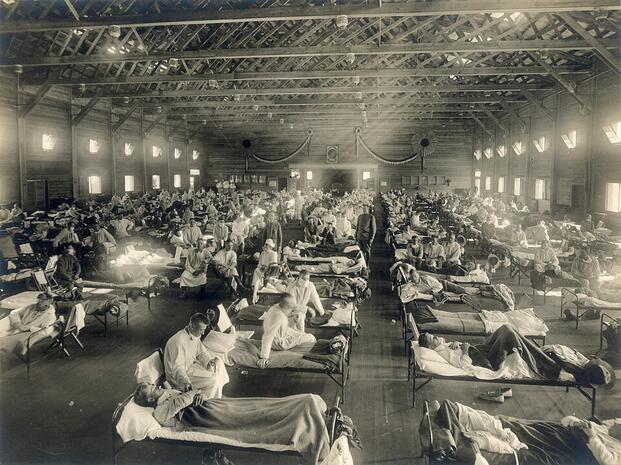
emergency_hospital_during_influenza_epidemic_camp_funston_kansas_-_ncp_1603
Emergency hospital during influenza epidemic, Camp Funston, Kansas. Emergency hospital during influenza epidemic (NCP 1603), National Museum of Health and Medicine.
In the winter of 1918, an illness was spreading in Haskell County, Kansas.
The remote farming community in the state’s southwestern corner sat roughly 300 miles from anywhere most Americans would recognize. Its residents raised hogs, tended cattle and scraped by on the prairie. But starting in January, a local physician named Dr. Loring Miner began seeing patients struck with an influenza unlike anything in his decades of practice.
This was not a typical seasonal illness. Strong, healthy adults were being knocked flat by violent headaches, high fevers and relentless coughs. Some of them died. Miner grew alarmed enough to file a formal warning to the U.S. Public Health Service, reporting an “influenza of a severe type.”
His alert was published in Public Health Reports, a weekly journal meant to flag outbreaks of communicable diseases. In the first six months of 1918, it would be the only mention of influenza anywhere in the world in that publication.
Nobody investigated the outbreak, but soldiers at the nearby Fort Riley would soon be hit by the new illness.
The First Cases at Camp Funston
What Miner could not have known was that young men drafted from Haskell County were already traveling back and forth to Camp Funston, a sprawling Army training installation on the grounds of Fort Riley in eastern Kansas.
The camp was one of 16 built across the country after the United States entered World War I in April 1917. At its peak, Camp Funston processed nearly 56,000 troops preparing for deployment to France.
Fort Riley sat on 20,000 acres of Kansas prairie. Thousands of horses and mules were stabled on the post, producing roughly nine tons of manure that soldiers burned each month. The smoke mixed with the region’s blinding dust storms to create a haze that hung over the installation.
Bone-cold winters gave way to stifling summers. Recruits lived in long rectangular barracks packed tight with bunks.
On the morning of March 4, 1918, an Army cook named Albert Gitchell reported to the camp infirmary with a sore throat, fever and headache. By noon, more than 100 soldiers had shown up with identical symptoms. Within a week, over 500 were hospitalized. After five weeks, 1,127 men at Fort Riley had fallen ill. Forty-six died.
The base surgeon diagnosed it as influenza. Military officials noted the outbreak but took no extraordinary action. The nation had bigger concerns. The war in Europe demanded every available body, and the Army was shipping tens of thousands of soldiers across the Atlantic each month.
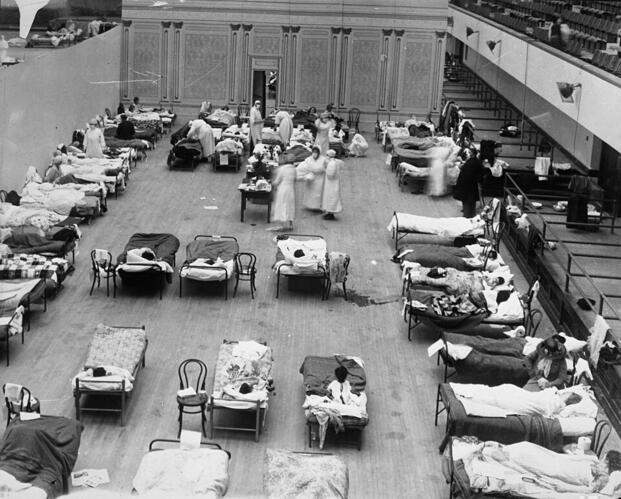
American Red Cross nurses tend to flu patients in temporary wards set up inside the Oakland Municipal Auditorium
The American War Machine Spreads the Disease
By April 1918, 24 of the 36 largest Army camps in the country were reporting influenza outbreaks. The virus spread with the constant stream of men transferring between installations for training, processing and deployment. In March alone, 84,000 American troops sailed for France. Another 118,000 followed in April.
The 89th and 92nd Infantry Divisions completed their training at Fort Riley and shipped out to French ports at Brest and Saint-Nazaire. Soon after they arrived, French soldiers in contact with the Americans began falling sick. British troops caught it next and carried the disease across the English Channel.
The Royal Navy reported more than 10,000 sailors stricken, effectively keeping parts of the fleet in port. The virus even spread into Germany, where 160,000 residents of Berlin soon contracted the illness.
The troopships themselves became floating incubators. Soldiers packed below decks in cramped quarters had no way to isolate the sick. The 15th U.S. Cavalry suffered 36 influenza cases and six deaths on a single Atlantic crossing. By war’s end, an estimated 12,000 American troops would die of influenza aboard transport vessels before ever reaching France.
By midsummer, the pandemic had reached Russia, North Africa, India, China, Japan, the Philippines and New Zealand. The first wave, while widespread, remained relatively mild. Most patients recovered within days. The death toll was notable but not catastrophic.
However, it had reached all corners of the world and would come back on an even worse scale.
Read the entire article on the Military.com website.
External Web Site Notice: This page contains information directly presented from an external source. The terms and conditions of this page may not be the same as those of this website. Click here to read the full disclaimer notice for external web sites. Thank you.