The Sinking of the Lusitania
Published: 7 May 2026
By James M. Lindsay
via the Council on Foreign Relations website
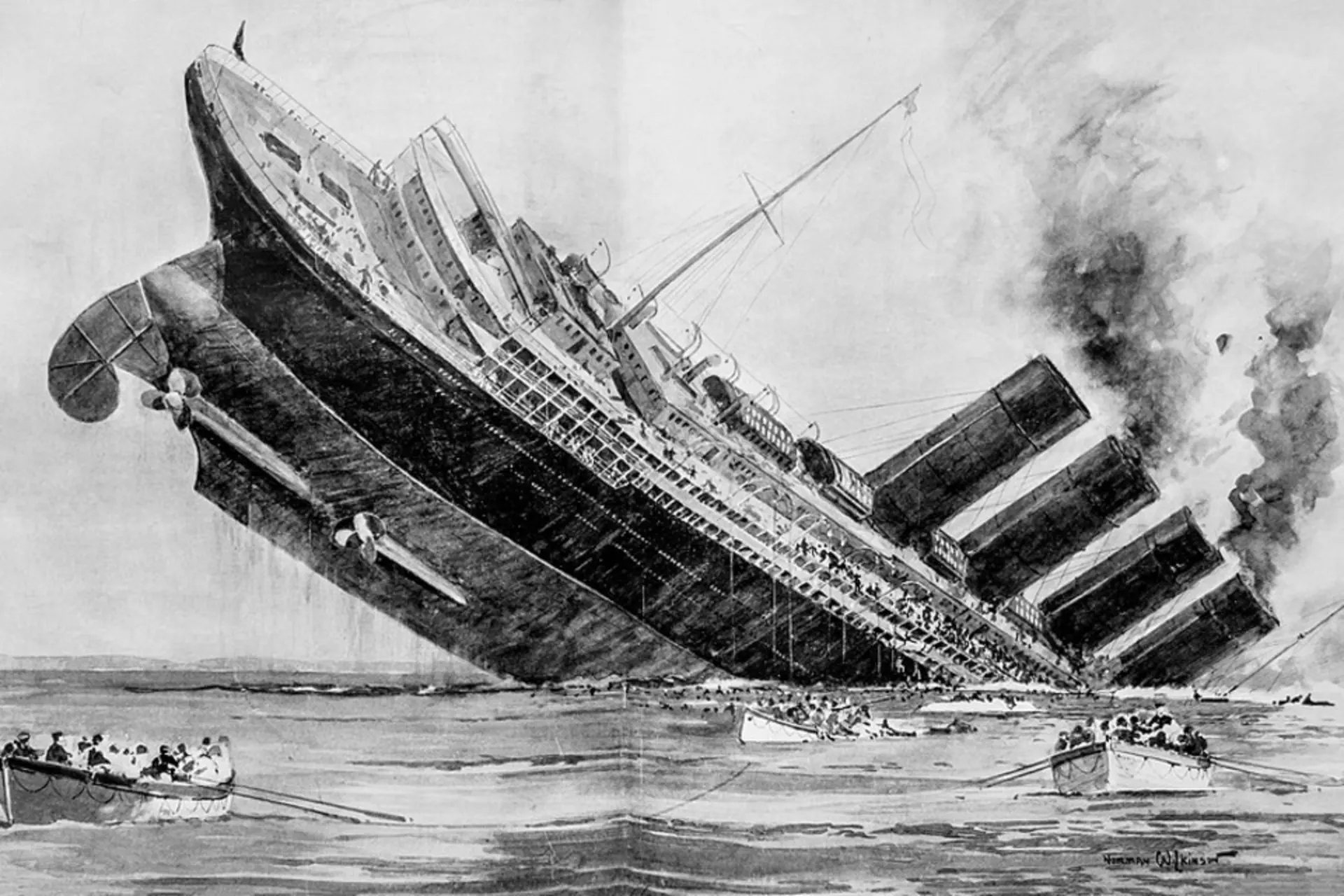
Sinking_of_the_Lusitania_London_Illus_News
Engraving by Norman Wilkinson depicting the sinking of the Lusitania in the Illustrated London News, May 15, 1915.
The death of 128 Americans in a German submarine attack horrified Americans but failed to push the United States into World War I.
Asking “what if” is a popular parlor game. Seldom, however, do we truly know the answer, and certainly not almost immediately. King George V of Britain is a rare exception. On the morning of May 7, 1915, he was discussing what might lead the United States to enter World War I with a visiting U.S. envoy, Colonel Edward M. House. The king asked: “Suppose they [the Germans] should sink the Lusitania, with American passengers on board?” Within hours he had his answer. It was likely not the one he wanted.
The Birth of Submarine Warfare
One of the frictions between Great Britain and Germany in the years leading up to World War I was the rapid buildup of the German Navy. When war broke out in August 1914, however, the British Navy quickly established dominance of the North Sea. In November, London announced that it considered the North Sea to be a combat area and effectively closed it to neutral traffic by mining the area and demanding that all neutral ships headed there to stop first at a British port. Few ships were allowed to make their onward journey to Germany.
Faced with what amounted to a blockade and unwilling to use its battleships and cruisers to challenge the British Navy, Germany retaliated by turning to what was then a relatively new military technology: the U-boat, or submarine. In February 1915, Berlin announced that the waters surrounding the British Isles constituted a war zone. Any vessel that entered the area was subject to being sunk without warning. The threat drew very little attention at first. At the time, Germany had just four submarines at sea. But their lethality would soon become evident.
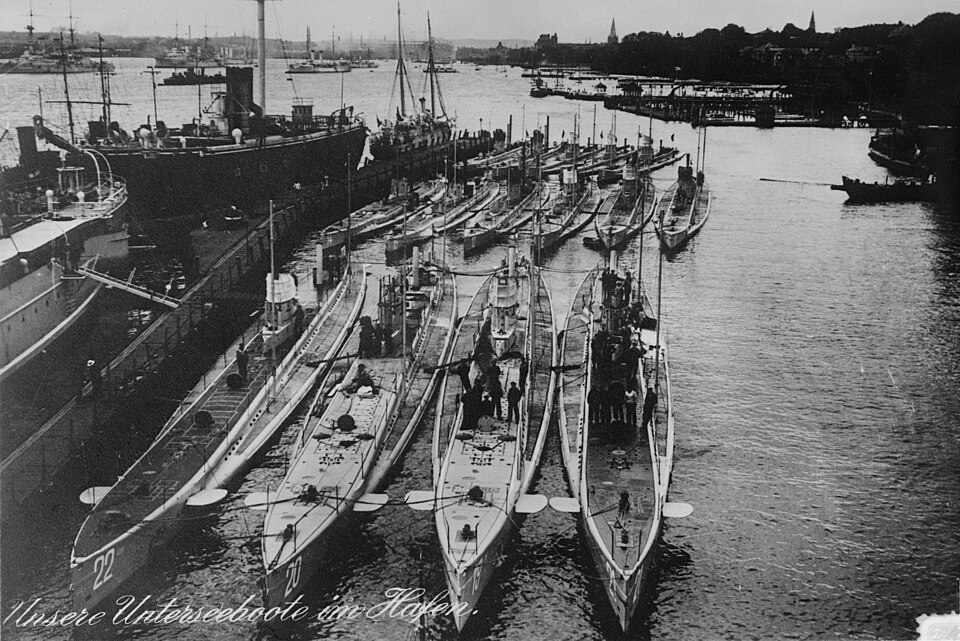
The German submarines U-22, U-20, U-19, and U -21 at Kiel, Schleswig-Holstein, February 17, 1914.
A Fatal Decision
May 7, 1915, was a beautiful day off the coast of southern Ireland. The morning’s fog had lifted, replaced by bright sunshine. The passengers on board the RMS Lusitania, the fastest and most luxurious cruise ship on the seas, eagerly anticipated their impending arrival in Liverpool, just six days after departing New York. The liner’s great speed and design were thought to protect it against a submarine attack.
What the passengers did not know as the Lusitania headed toward the Irish Sea in the early afternoon, just a dozen miles off the Old Head of Kinsale on Ireland’s southern coast, was that a German submarine, U-20, had spotted the liner. The Lusitania’s captain had known about possible submarine activity in the area but had ignored guidance to plot an evasive course.
It was a fatal mistake. At 2:10 p.m., U-20 fired one of its two remaining torpedoes. It was a direct hit. The “Greyhound of the Seas” sank in just eighteen minutes. Nearly 1,200 people died, including 128 Americans.
A Shocked American Public
The sinking of the Lusitania horrified Americans at the time, much as Pearl Harbor and September 11 would shock future generations. Unlike those two tragedies, however, the horror did not translate into swelling public support for war.
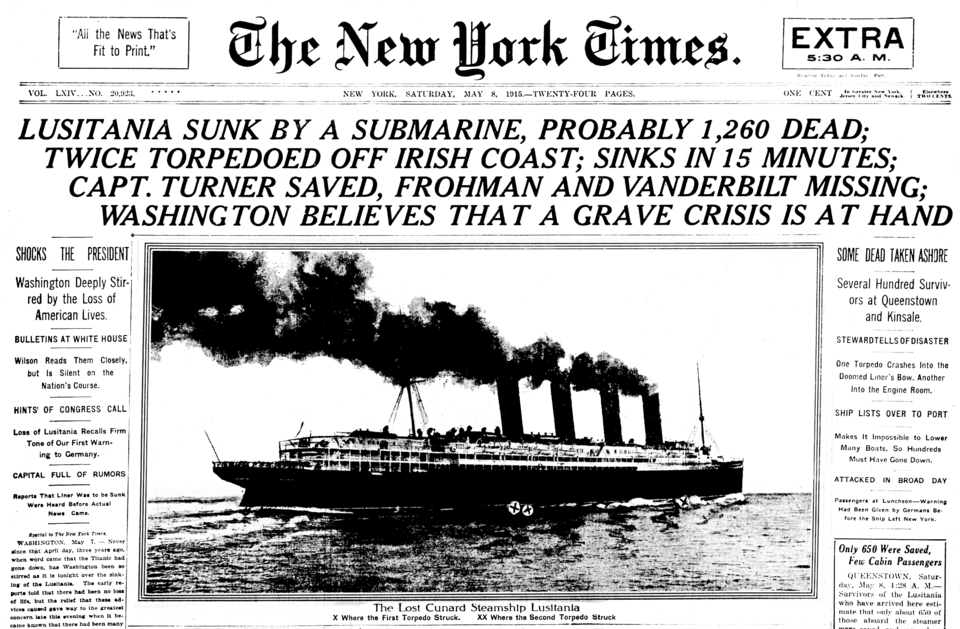
Front page of the New York Times, May 8, 1915.
Some Americans did see the sinking as a cause for war. Former President Teddy Roosevelt, who thought that Wilson had erred nine months earlier in proclaiming U.S. neutrality, denounced the attack as barbarous and demanded a confrontation with Germany. So did some newspapers. The day after the Lusitania sank, the New York Herald ran a headline exclaiming, “WHAT A PITY THEODORE ROOSEVELT IS NOT PRESIDENT!”
The British government’s release of the Bryce Report five days after the Lusitania sank further inflamed American public anger. The report detailed (and exaggerated) atrocities German troops had committed after invading neutral Belgium in August 1914. Germany was one of the signatories to the treaty guaranteeing Belgian neutrality, and it had repeated its pledge to honor the treaty only a year before the war started.
As horrified as most Americans were at the atrocities committed in Belgium, the duplicity of German behavior, and the thought of civilians being left to drown on the high seas, they recoiled at the thought of joining a war in Europe. They still treated George Washington’s advice to stand apart from Europe and Thomas Jefferson’s warning against “entangling alliances” as gospel.
Ethnic politics also played a role. Irish Americans had no interest in helping Britain while it denied Irish independence. German Americans sympathized with their ancestral homeland. And still other Americans saw no virtue in either war or in joining squabbling European powers. When New York newspapers asked editors around the country how the United States should respond to the Lusitania’s sinking, only six out of the thousand who responded urged war.
Read the entire article on the Council on Foreign Relations website here:
External Web Site Notice: This page contains information directly presented from an external source. The terms and conditions of this page may not be the same as those of this website. Click here to read the full disclaimer notice for external web sites. Thank you.