WWI Stifled the Peace Message of Early Mother’s Days
Published: 7 May 2026
By Lesley Kennedy
via the History.com website
mothersDay_uimq3p
Mother’s Day Began as a Peace Movement
In the wake of bloody 19th-century wars, the holiday’s early advocates urged communities to gather in peace.
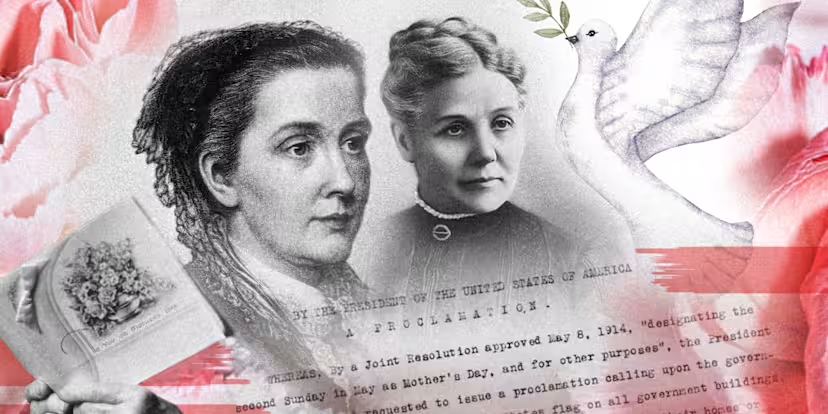
Before Mother’s Day became a $38 billion celebration of brunch, bouquets and greeting cards, it was about peace. In the aftermath of the Civil War, two women—Ann Reeves Jarvis of West Virginia and Julia Ward Howe of Boston—imagined a day when mothers would gather not to be honored but to heal divided communities.
The earliest Mother’s Day observances were not sentimental, according to Katharine Antolini, historian and author of Memorializing Motherhood: Anna Jarvis and the Struggle for Control of Mother’s Day. They grew from the belief that mothers had a civic duty to protect life and promote peace.
One of the clearest examples came from Howe, whose 1870s call for women to gather each June 2 to sing, pray and reflect was meant as a rallying cry. “The theme of all or any of these should still be how to bring God’s peace on earth,” Howe urged, according to Memorializing Motherhood.
Ann Reeves Jarvis: Working to Reunite Divided Communities
Of Ann Reeves Jarvis’ 13 children, only four survived to adulthood. (The exact number of children Jarvis had is disputed, though sources report between 11 and 14.) At least four of her kids died from measles in 1862 alone. One of her surviving daughters, Anna Maria Jarvis, later described her mother’s life as one marked by “care, anxiety, illness, sorrow and self‑sacrifice,” Antolini writes in Memorializing Motherhood.
Still, Jarvis organized Mothers’ Day Work Clubs beginning in 1858 to fight epidemics such as measles, typhoid and diphtheria that devastated Appalachian towns. The clubs educated families on sanitation, inspected milk, provided medicine and quarantined homes.
The Civil War changed Jarvis’ focus, however. According to the Smithsonian American Women’s History Museum, “Jarvis insisted that the women’s groups she organized help both Confederate and Union troops who were sick or wounded, and she worked to promote peace and unity following the war.”
Jarvis organized a Mother’s Friendship Day in 1868 to “bring families from both sides of the war together to try to restore a sense of community,” per the museum. According to Memorializing Motherhood, many veterans arrived, allegedly while armed, and town officials begged her to cancel.
She refused.
Jarvis stood before the men, “flanked by two teenage girls dressed in blue and gray, and keenly explained the gathering’s message of forgiveness and unity,” Antolini writes. “Eventually, more women dressed alternately in blue and gray came forward to link hands with Jarvis, and they led the crowd in choruses of ‘Dixie’ and ‘The Star-Spangled Banner.’” Witnesses recalled veterans “weeping and shaking hands,” saying, “God bless you, neighbor; let us be friends again.”
External Web Site Notice: This page contains information directly presented from an external source. The terms and conditions of this page may not be the same as those of this website. Click here to read the full disclaimer notice for external web sites. Thank you.