“She Was Glorious”—The Pre-Sinking History of RMS Lusitania
Published: 29 April 2026
By Kimball Worcester
via the Roads to the Great War website
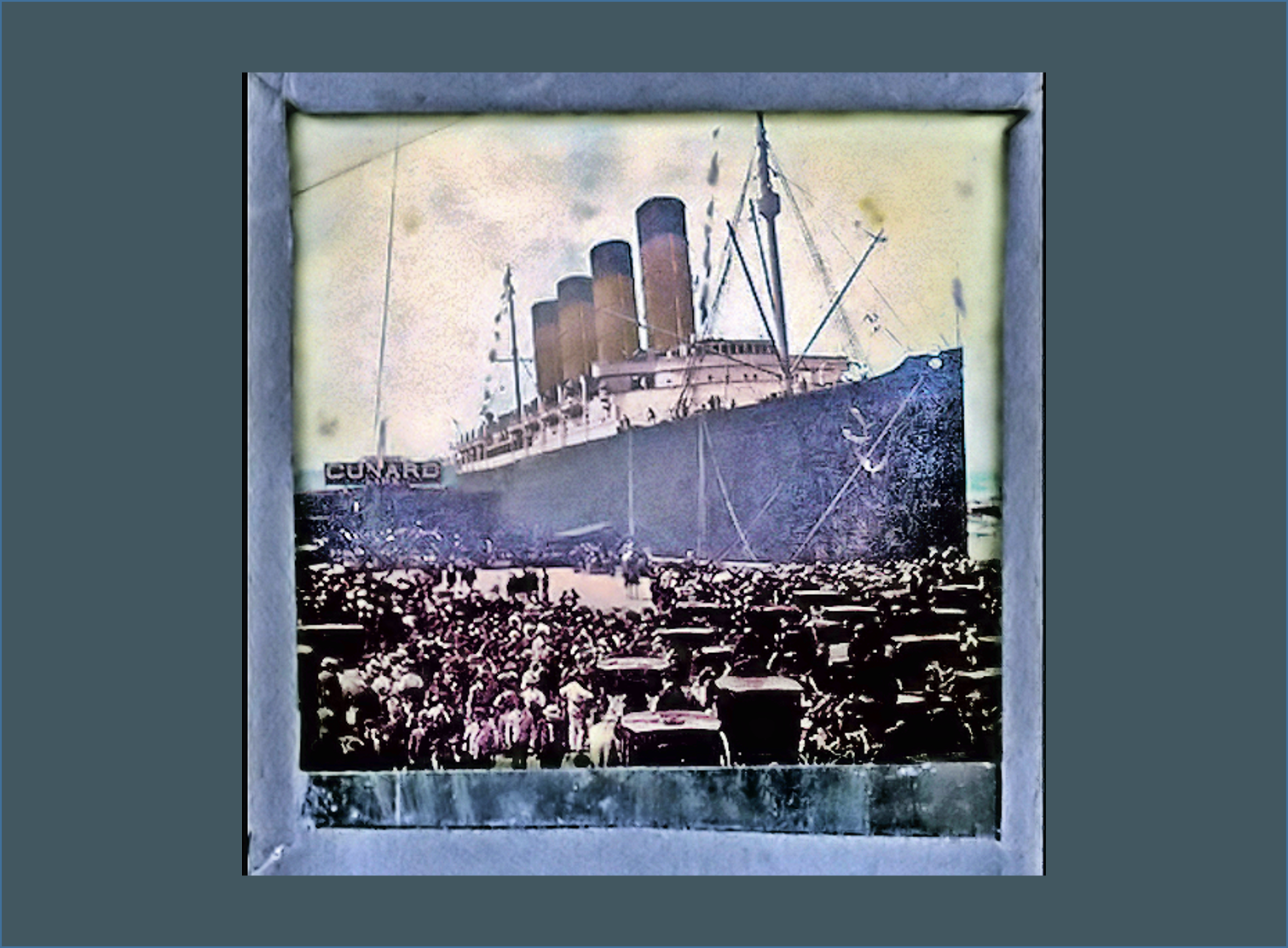
Lusitania
Lusitania Arrives in New York.
Inception
The Liverpool-based shipping company Cunard ordered the R.M.S. Lusitania and its sister ship, the R.M.S. Mauretania, in 1902. Lusitania was built by the shipyard of John Brown & Co. in Scotland. For Cunard, the two ocean liners had a shared purpose: to restore Britain’s dominance in the transatlantic passenger travel industry by beating its German (and, to a lesser degree, American) competition. To build the Lusitania and Mauretania, Cunard secured a £2.6 million, low-interest subsidy from the British government (in today’s currency, that’s about £300 million). Cunard also received an annual operating subsidy of £75,000, or about £8.6 million today, for each ship, and a contract worth £68,000 each, or £7.8 million today, to transport mail. The ships were designed to accommodate 563 first-class, 464 second-class, and 1138 third-class passengers, plus 802 crew.
As another part of the loan arrangement, Cunard guaranteed that both ships would be able to cruise at a speed of at least 24.5 knots (about 28 mph). That would make the Lusitania and Mauretania faster than the speediest German liners, which could run just over 23 knots. To meet this challenge, Cunard installed four steam turbine engines, each with its own screw propeller, a first for ocean liners. The new technology in the Lusitania required “68 additional furnaces, six more boilers, 52,000 square feet of heating surface, and an increase of 30,000 horsepower.”
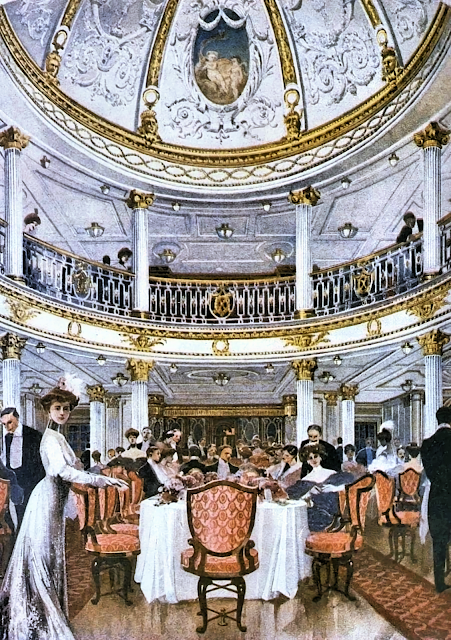
First Class Dining, RMS Lusitania
The Very Best Accommodations
The ship was promoted as a “floating palace,” featuring a two-story dining salon, a veranda café, a smoking room, electric lighting, and elevators. First class passengers enjoyed lavish suites. Each class of passenger accommodation featured dining rooms, smoking rooms, ladies’ lounges, nurseries, and other public spaces. They ranged in opulence from plush Georgian and Queen Anne styles in the first-class compartments to plain but comfortable in third class. The Lusitania was also the first ocean liner to have elevators, as well as a wireless telegraph, telephones, and electric lights.
Onboard dining included dozens of dishes at each seating for the most discerning Edwardian gastronomes. A luncheon menu from January 1908 suggested appetizers like potted shrimps, omelette aux tomates, lamb pot pie, and grilled sirloin steak or mutton chops. A variety of cold meats—Cumberland ham, roast beef, boiled ox tongue, boar’s head, and more—was served next. For dessert, guests could nibble on fancy pastry, compote of prunes and rice, cheeses, fruits, and nuts.
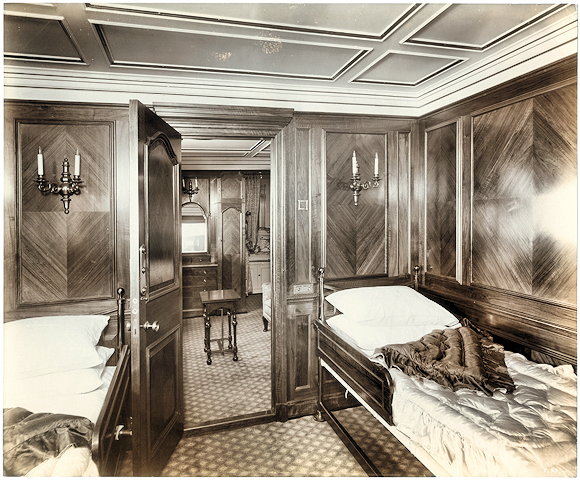
First Class Sleeping Accommodation
Prewar Operations
On 7 September 1907, the Lusitania departed Liverpool on its maiden voyage enroute to New York with a stop in Queenstown (now Cobh), Ireland. “She presented an impressive picture as she left with her mighty funnels and brilliant illuminations,” the Manchester Courier and Lancashire General Advertiser reported. “Throughout the day there was a continuous stream of sightseers on board, and the departure was witnessed by about 200,000 people.”
Cunard desperately wanted to win back the Blue Riband, an unofficial title for the fastest average time on a crossing of the Atlantic Ocean, from the German superliners. Bad weather prevented the Lusitania from reaching its top speed on the first try, but on the voyage from 6–10 October 1907, the ship reached an average speed of 23.99 knots, breaking the Germans’ record. She soon became known as the “Greyhound of the Seas.”
Read the entire article on the Roads to the Great War website here:
External Web Site Notice: This page contains information directly presented from an external source. The terms and conditions of this page may not be the same as those of this website. Click here to read the full disclaimer notice for external web sites. Thank you.