Where Did General Pershing Get His Initial Division for the AEF?
Published: 1 May 2026
By Michael Hanlon
Special to the Doughboy Foundation website
First Division header
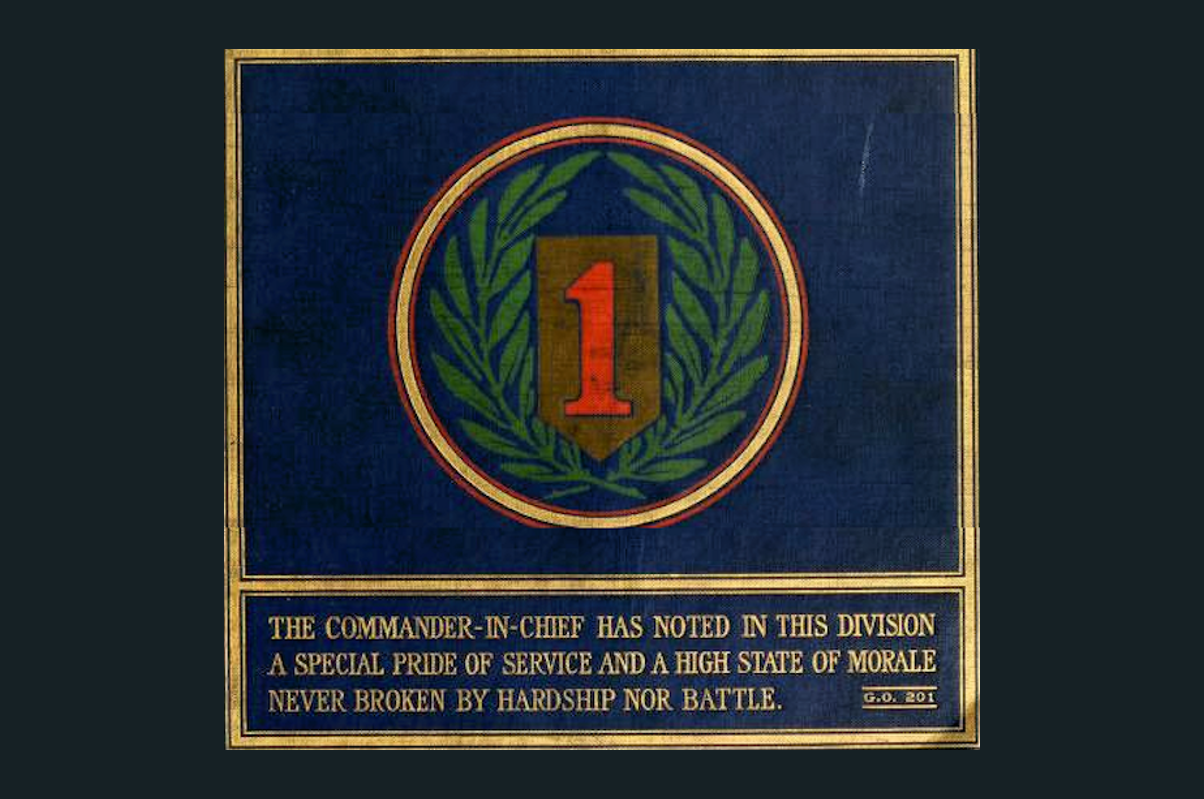
When the U.S. Army began the conversion to brigade combat teams in 2004, it started to move cautiously away from the combined arms division, the Army’s building block for nearly 90 years. The first permanent divisions were created amid the crisis conditions of 1917, and the first among these new formations was the 1st Division, today’s 1st Infantry Division, the famous Big Red One.
Its formative experience preparing for combat on the Western Front in World War I challenged soldiers of that day in ways their counterparts of today might recognize—raw recruits manning a new organization; extreme personnel turbulence; unfamiliar technology; precarious relationships with allies; doctrinal uncertainty; harsh living and training conditions; and the prospect of imminent combat with a hardened and dangerous enemy. The organization they honed did more than break a path for the 42 divisions of the American Expeditionary Forces (AEF) that followed—it set the foundation for the modern, permanently organized, combined arms divisions that characterized the U.S. Army for the rest of the 20th century.
The idea of permanent divisions percolated throughout the U.S. Army for at least 20 years prior to 1917. The basic formation for more than a century had been the single-arm regiment. Temporary “divisions” had been formed in the Civil War and the Spanish-American War to consolidate commanders’ span of control and to combine infantry and field artillery.
While the major European powers organized divisions in the late 19th and early 20th centuries, the U.S. Army had no similar compelling need as it policed the western frontier and America’s new colonial holdings. Wartime divisions were codified in the 1905 Field Service Regulations (FSR), but the central argument for forming permanent divisions between 1900 and 1917 was for the unlikely contingency of continental defense against a major power.
From 1910, instability in Mexico provided opportunities to experiment with divisions. In 1911, the War Department assembled a provisional “maneuver division” of Regular and National Guard units in San Antonio, Texas. The assembly itself required nearly the entire period of the call-up, from March to August. The event provided relevant experience, leading to a more efficient mobilization of the 2d Division in Texas in 1913 and deployment of a brigade to Vera Cruz, Mexico, in 1914. Meanwhile, an Army War College study recommended reorganizing the Regular Army as a “mobile army” of divisions ready for immediate service. Moreover, the 1914 FSR called the division the basic organization for offensive operations.
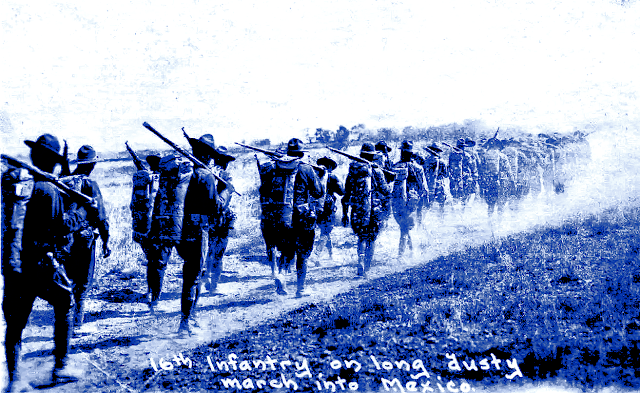
16th Infantry Marching into Mexico, 1916
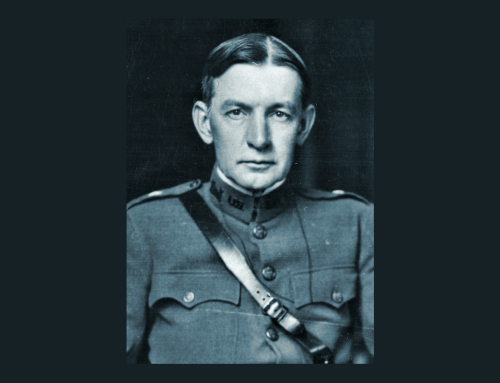
The FSR further defined a division in modern terms: “A self-contained unit made up of all necessary arms and services, and complete in itself with every requirement for independent action incident to its operations.” The War College plan, however, was never completely adopted or funded. The onset of World War I in Europe led to the National Defense Act of 1916, which expanded both the Regular Army and the National Guard and called for the organization of both into permanent tactical brigades and divisions. Events overtook this plan as well. In response to Pancho Villa’s raid on Columbus, New Mexico, in March 1916, 8th Brigade, 3d Division, commander BG John J. Pershing received orders to organize a force to apprehend Villa’s gang.
Pershing assembled the “Punitive Expedition,” a provisional division of two cavalry and one infantry brigades and, for the next year, conducted the first modern division operations in the Army’s history. Although ultimately unsuccessful, the expedition integrated radio and telephone communications, airplanes, and partly motorized logistics with ground maneuver and provided Pershing and others a taste of the complexities of 20th-century warfare.
While Pershing led his expedition through the wilds of northern Mexico, events in Europe brought the United States into World War I. Germany’s leaders decided to strangle Great Britain with unrestricted submarine warfare and, clumsily, to arrange a Mexican attack on the United States in the event of the latter’s entry on the Allied side. President Woodrow Wilson requested and received a Congressional declaration of war on 6 April 1917. Great Britain and France immediately pressed for the deployment of an American division.
It is hard to exaggerate the crisis of 1917 for the U.S. Army. Pershing’s expedition had only been withdrawn from Mexico in February, having consumed most of the quartermaster’s meager stocks. The four extant divisions were administrative groupings, not trained, deployable units. There were no plans for manpower or industrial mobilization, no stocks of weapons and munitions, and no plans for transporting a significant military force over contested seas.
Read the entire article on the Roads to the Great War website here:
External Web Site Notice: This page contains information directly presented from an external source. The terms and conditions of this page may not be the same as those of this website. Click here to read the full disclaimer notice for external web sites. Thank you.