P520 Crash Boat planning Honor Cruise for WWII/Korea vets to DC on July 4th; support sought
Published: 29 April 2026
By Ted Yadlowsky
Special Warfare & Rescue Vessel Foundation
P520 sunset
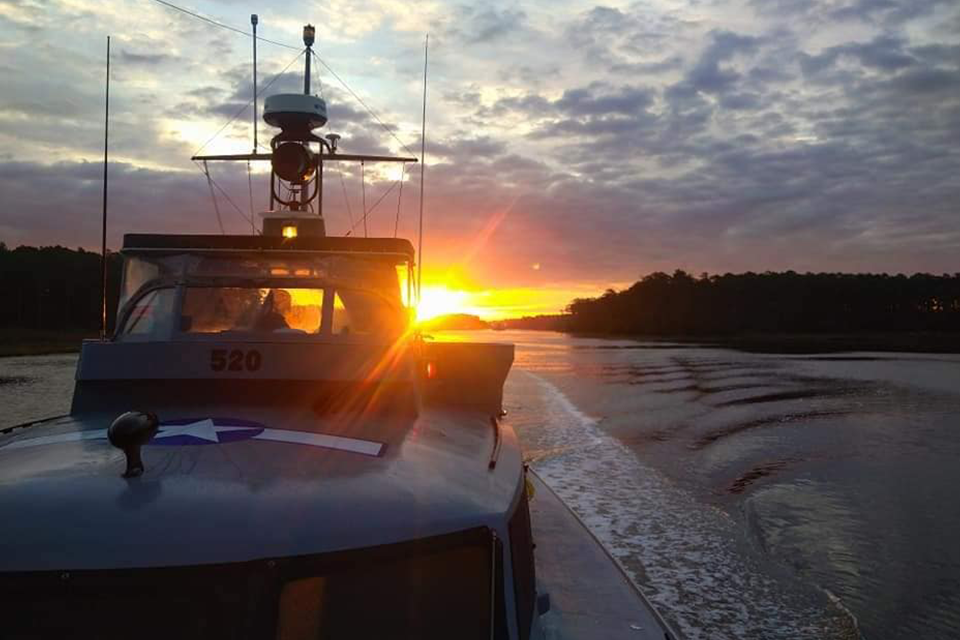
The P520 underway on the Chesapeake Bay.
Unique watercraft has deep WWI connections
When fundraising is successful, the P-520, the last complete 85′ WWII & Korean War US Army/Air Force Patrol Boat (Crash Boat) remaining afloat, will visit Washington, DC this July 4th to host several WWII and Korean War veterans in an Honor Cruise for the America 250 celebrations. However, what most of those aboard the vessel may not realize is the deep World War I legacy that is represented by the P-520.
During WWII, the primary mission of the 85-foot “crash boats” (the “85’s”) was to find and recover downed US Army Air Corps airman who had to ditch their plane over the sea. The 85’s were built after crews wanted a boat with greater range than the 63-foot crash boats offered, and more speed than the 104-foot crash boats could provide.
The 85’ P-520 is the only complete example of this class of boat. Many of her famous sister vessels took part in daring missions and rescues in every theater of war during WWII. Many 85’s were later recalled back for duty to serve in the Korean War.
But while rescue was their stated mission, the boats played other, less well-known roles. The Office of Strategic Services (OSS), which later became the CIA, used the 85’s for special maritime units. U.S. Army Lieutenant Walter Mess was put in charge of this OSS Maritime Unit, and along with Dr. Christian Lambertsen (called the “Father of American SCUBA”) used these vessels to attack the Japanese in the China Burma India Theater. Lambertsen, the inventor of the LARU rebreather, sabotaged many Japanese targets in secret.
During the Korean War the 85’s were again used to go behind enemy lines, this time in North Korea and China, to deploy North Korean partisan fighters and perform covert operations. These missions were mostly classified up until the 1990’s.
Another use of the 85’s was a top secret project by the OSS to develop the first Unmanned Attack Sea Drones during WWII. Called Operation Javaman, the project utilized a modified B-17 Flying Fortress bombers as airborne control platforms, employing television cameras and infrared searchlights to guide the 85’s to their targets via remote control miles away. Despite successful testing in 1944, the project was never deployed in combat. We see this technology today with the war in the Ukraine.
P-520 was restored by a group of WWII and Korean War crash boat vets. They spent millions restoring this vessel so that it could someday tell the story of their service. The P-520 is a unique vessel: the last complete serving member of an exotic nautical branch of the US Army, Air Force, OSS & CIA in WWII & the Korean War. But where does World War I come in?
You will hear the answer when you see the P-520 underway: that mighty roar comes from twin Detroit 12V71’s, which are safer and more fuel efficient today. But when P-520 and her sister vessels were built, they were powered by two 4M-2500 V12 Packard engines that derive from the V12 liquid-cooled aircraft engine designed by Packard in 1924 as a successor to the famous World War I-era Liberty L-12 aircraft engine. During WWI, as well building the influential Liberty V12, Packard was a vital supplier to the US military, providing over 10,000 Model E 3-ton trucks and developing. Known for engineering quality, Packard became a top-tier government supplier, contributing both durable logistical transport for the European theater and critical, mass-produced power plants for Allied aircraft. Thus, the technology that powered the 85’s during WWII and Korea, and the P-520 now, is a straight-line connection to WWI.
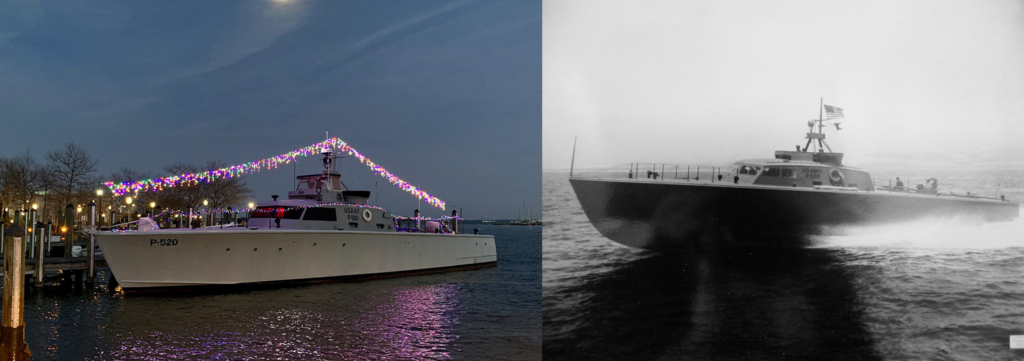
The P520 now at her berth in Maryland (left) and then, underway on the Pacific Ocean during World War II.
But there is a quiet WWI link as well: the 85’s were built during WWII in a number of shipyards that cut their teeth on military vessel construction during World War I. Once such yard is the Stephens Brothers of Stockton, CA. The company, founded by brothers Theodore and Robert Stephens in 1902 in their backyard in Stockton, were active in the local boatbuilding industry during WWI, building small launches and work boats like the Gee Whiz and the Fred F. Lambourn speedboat. Their work from the WWI era onward paid off two decades later: just eight days after Pearl Harbor, on December 15, 1941, Stephens Brothers launched its first war vessel for the US Navy (the YMS 94 minesweeper), and later built the 85’s for the U.S. Army Air Forces to rescue downed pilots.
Another example: during World War I, the Herreshoff Manufacturing Company in Bristol, RI, pivoted from luxury yacht building to critical military production, constructing vessels like the USS Apache (SP-729), which was part of a series for the US Navy. Under Nathanael G. Herreshoff, the firm specialized in high-speed, high-quality torpedo boats, motor boats, and submarine chasers for the U.S. Navy, leveraging its integrated design and manufacturing capabilities for the war effort. When WWII came to American shores, Herreshoff’s expertise and innovative boatbuilding knowledge gained in WWI enabled them to lead in the development of fast, efficient WWII craft like the 85’s.
So the P-520 is a one-of-a-kind: the last complete surviving member of a unique class of boats that served in WWII and Korea, rescuing downed airmen and performing clandestine missions, with a strong WWI legacy. The WWII and Korean War veterans aboard will also have a one-of-a-kind experience on July 4, if the Special Warfare & Rescue Vessel Foundation, operators of the P-250, can raise the funds for the planned Honor Cruise. If you would like to support this special event to honor WWII and Korean War vets, you can make a donation here,
External Web Site Notice: This page contains information directly presented from an external source. The terms and conditions of this page may not be the same as those of this website. Click here to read the full disclaimer notice for external web sites. Thank you.