Woodrow Wilson Asks Congress to Declare War on Germany
Published: 2 April 2026
By James M. Lindsay
via the Council on Foreign Relations website
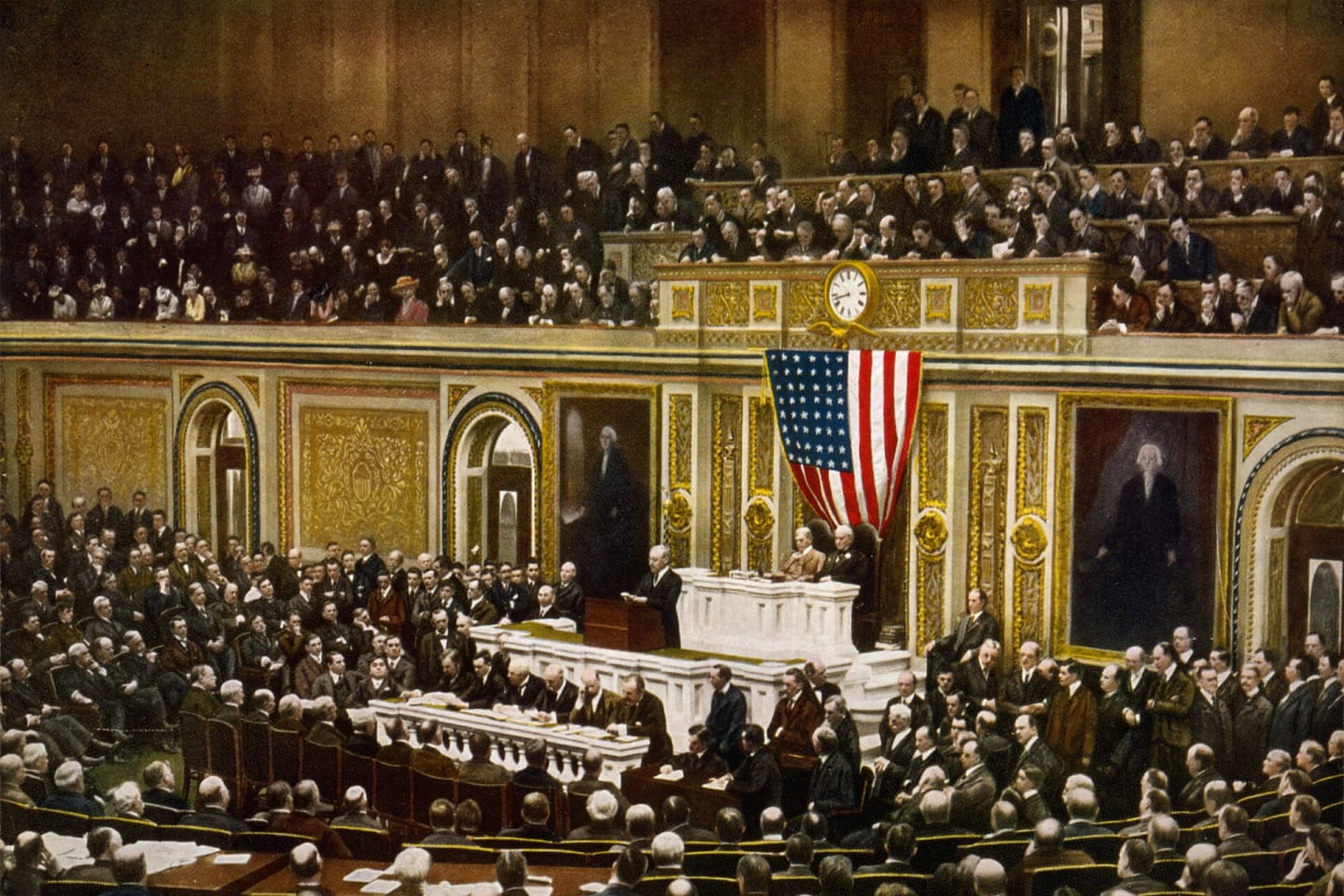
President_Woodrow_Wilson_asking_Congress_to_declare_war_on_Germany_2_April_1917_396063838c3
President Woodrow Wilson speaking before a joint session of Congress to request that it declare war on Germany, April 2, 1917. (Library of Congress.)
Presidential campaign promises can be easier to make than to keep.
Presidents win elections by making promises to voters. Sometimes they break those promises. Donald Trump is an obvious case in point. He campaigned in 2024 vowing: “I’m not going to start a war. I’m going to stop wars.” The United States is now at war with Iran.
You might think that Trump stands alone in breaking a campaign pledge to keep the United States out of war. After all, reneging on a promise not t send U.S. troops into harm’s way is qualitatively different from breaking a pledge not to raise taxes. But you would be wrong. Just ask Woodrow Wilson. He ran for reelection in November 1916 vowing to keep the United States out of World War I. Yet five months later, on April 2, 1917, he stood in the well of the House of Representatives and advised Congress to declare war on Germany.
In a recent survey that the Council on Foreign Relations conducted, members of the Society for Historians of American Foreign Relations ranked the U.S. entry into World War I as the sixteenth best decision in U.S. foreign policy history. Time will tell how historians, and the American people, judge Trump’s decision to launch Operation Epic Fury.
A Domestic Policy President
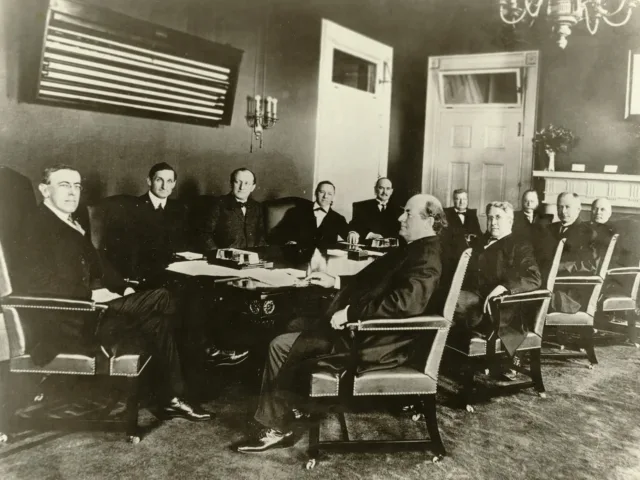
President Woodrow Wilson at his first cabinet meeting, 1913. (National Archives)
Foreign policy, let alone war, was far from Woodrow Wilson’s mind when he won election in 1912. He was headed to Washington to tackle domestic problems. He had defeated incumbent Republican President William Howard Taft and third-party candidate and former President Theodore Roosevelt with his promise of a New Freedom, an ambitious call to expand the federal government’s role in promoting economic competition and protecting worker rights.
Wilson spent much of his first term making good on his promise. Among other things, he persuaded Congress to institute a graduated federal income tax, establish the Federal Reserve and the Federal Trade Commission, and prohibit child labor.
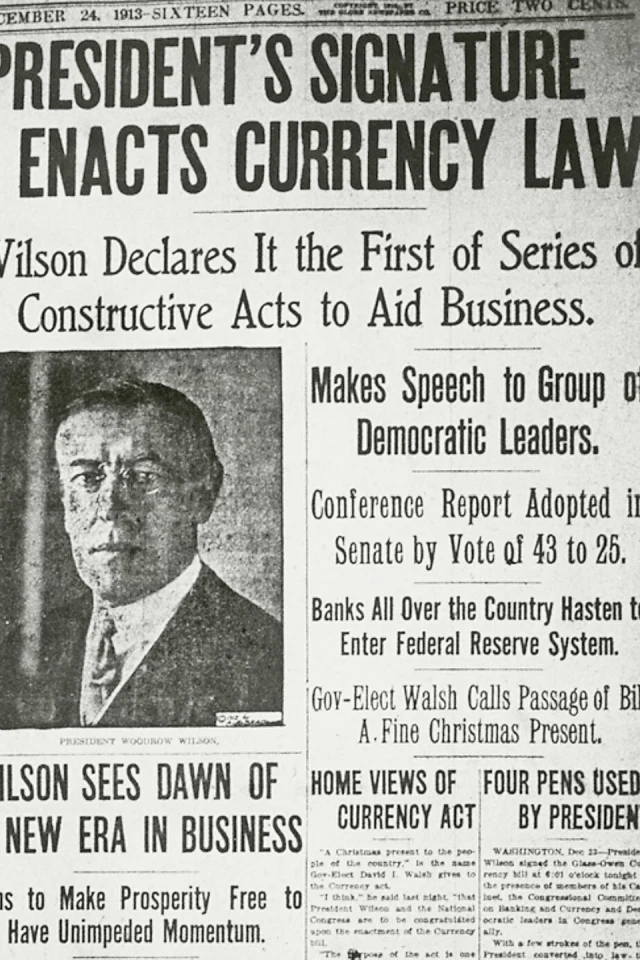
Newspaper frontpage announcing President Woodrow Wilson’s signing of the Federal Reserve Act, December 24, 1913.
Despite his focus on America’s problems at home, Wilson knew that he might be tested by events overseas. He told an old colleague shortly before being sworn in as president on March 4, 1913: “It would be the irony of fate if my administration had to deal chiefly with foreign problems.”
Wilson was likely thinking about problems with America’s neighbors to the south when he made that remark. The Mexican Revolution had begun in 1911, and the Taft administration had intervened in Cuba, the Dominican Republic, and Nicaragua. Relations with Latin America would indeed test Wilson. But his defining foreign policy challenge, and the one that etched his name on the list of most consequential U.S. presidents, came from another direction entirely.
Europe Declares War, the United States Declares Neutrality
Europe erupted in war in August 1914. Americans may have viewed the news as a tragedy; they did not see it as affecting their own security. Since the days of Washington’s Farewell Address, Americans had strenuously avoided what Thomas Jefferson called “entangling alliances” with Europe. So it was unsurprising that Wilson responded to the war’s outbreak by declaring the United States neutral.
Read the entire article on the Council on Foreign Relations website here:
External Web Site Notice: This page contains information directly presented from an external source. The terms and conditions of this page may not be the same as those of this website. Click here to read the full disclaimer notice for external web sites. Thank you.