WWI Pilot Took on Nine Germans to Save His Wingman. His Lost Medal of Honor Still Awaits Justice
Published: 2 March 2026
By Allen Frazier
via the Military.com website
AP-17 Swarm 2
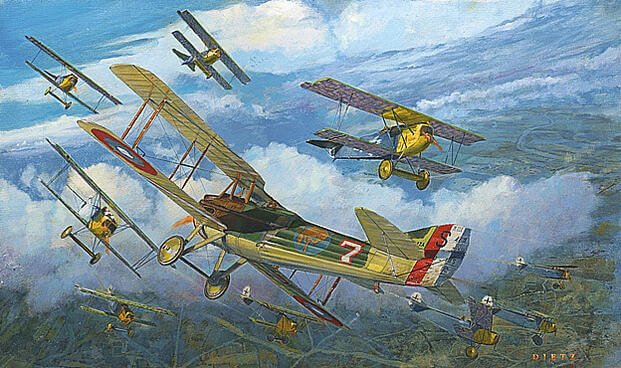
The Swarm, November 6, 1918, by renowned aviation artist James Dietz, captures the pivotal moment when Bill confronted his nine adversaries, alone. (The Soft Mud of France)
Gregory Vail grew up listening to his father’s war stories, watching him struggle with a prosthetic leg and agonizing phantom pain, hearing his anguished screams in the dark of sleepless nights. For 64 years after World War I, 1st Lt. William H. Vail lived with the consequences of 15 minutes of aerial combat over France.
On Nov. 6, 1918, the 95th Aero Squadron pilot voluntarily engaged nine German Fokker D.VII fighters alone and saved the life of a fellow aviator. Vail’s adversaries peppered his Spad XIII No. 7 with upwards of 150 rounds of machine gun bullets, one or more striking his left leg below the knee, shattering it. He crashed into a farm field and survived only because the soft mud cushioned his impact and enveloped him in an earthen scab that kept him from bleeding to death.
His commanders recommended him for both the Distinguished Service Cross and the Medal of Honor. He received the DSC and later the Silver Star and the Purple Heart. The Medal of Honor recommendation vanished into Army bureaucracy and was never seen by Gen. John J. Pershing for adjudication.
Now, 108 years later, William Vail’s only son is working to finally secure the nation’s highest military honor for his father’s actions.
“I always felt I needed to redeem him,” Greg, 75, told Military.com. “He sacrificed over and over again for other people, and me. All these extraordinary things he did, I need to redeem him and thank him.”
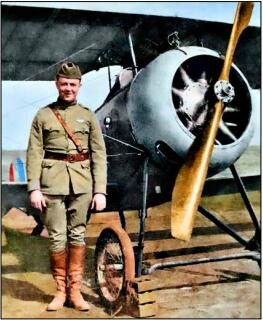
Bill Vail with Nieuport trainer at Cazaux Aerial Gunnery School, March 1918. Vail archive. (The Soft Mud of France)
Gregory Vail
Greg is likely one of the youngest of the handful of surviving direct offspring of a World War I veteran. His father was 53 when Greg was born in 1950.
“When I tell people I’m the son of a World War I fighter pilot, they say, ‘You mean the grandson?’ I say no, I’m the son,” Greg said.
Greg graduated with honors in history from Stanford University in 1973, where he studied under renowned historian Gordon A. Craig. He wanted to write his senior thesis about his father’s pursuit pilot days, but Craig dissuaded him, saying many others had written such chronicles.
Instead, Greg became an unintended expert on German zeppelins bombing London during the Great War. He later earned a master’s degree in landscape architecture and spent four decades in land planning and community development before turning to his father’s story.
“I was a witness to and lived for over 30 years with a veteran of that long-ago era, who did one thing that affected everything else, still reverberating today.” Vail said. “Because I was a first-hand witness to my father’s life and his history, recording and getting the story out there is important for posterity.”
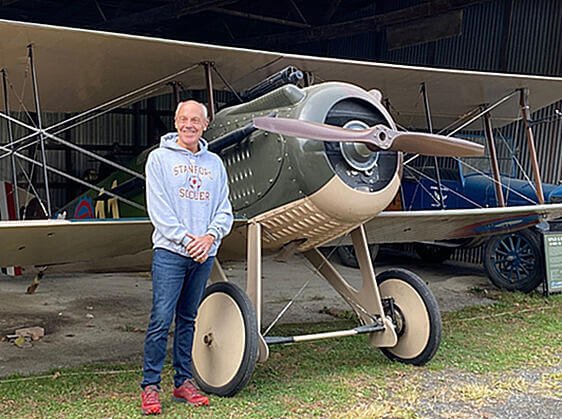
Gregory Holland Vail at Old Rhinebeck Aerodrome, October 20, 2020. Vail family photo. (The Soft Mud of France)
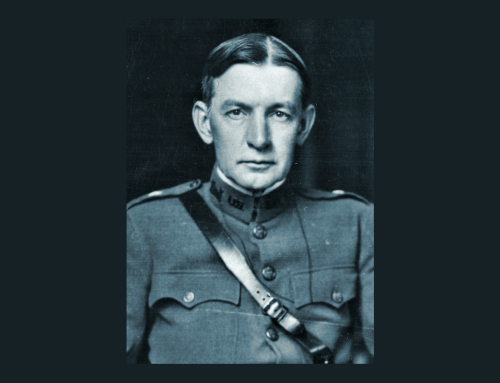
William “Bill” Vail
William Henry Heegaard Vail, born in 1897, first saw an airplane in 1911 at a Chicago air show and became fascinated with aviation. When the U.S. entered World War I in 1917, he knew he would be drafted and saw what was happening in the trenches of France. Attrition and mud and horrendous death, or the worse purgatory of mutilation from wounds, mustard gas and disease.
“He wanted to serve his country, but he pondered whether there was something that would avoid the horrendous likely consequences of the trenches,” Greg said. “He landed on the fledgling Air Service, a subdivision of the Army Signal Corps, which was then a small part of the military.”
William Vail understood the average lifespan of a pursuit pilot after arriving at the front was six weeks. The planes were wooden crates covered in cloth that ripped off in flight. Engines failed constantly. No parachutes. No radios. Few instruments.
“His calculation was he would come out of the war in one piece or not at all,” Greg said. “He was dead wrong. He came out alive and broken.”
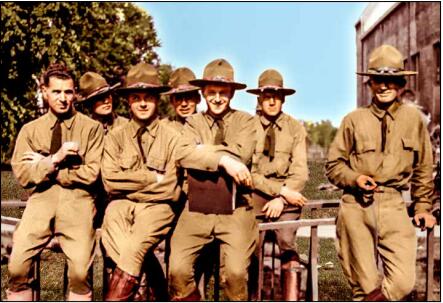
Air cadets at the University of Illinois Urbana Champaign Ground School, summer 1917. Bill third from left. Vail archive. (The Soft Mud of France)
Before reaching the front, William Vail reportedly accumulated approximately 1,000 flying hours ferrying aircraft from factories to airfields. He hated the relative safety of ferry duty and fought constantly to get into combat.
He finally arrived at the 95th Aero Squadron at Rembercourt Aerodrome in late September 1918, just as the Saint-Mihiel and Meuse-Argonne offensives kicked off.
Read the entire article on the Military.com website.
External Web Site Notice: This page contains information directly presented from an external source. The terms and conditions of this page may not be the same as those of this website. Click here to read the full disclaimer notice for external web sites. Thank you.