The Last Trench of the Great War
Published: 15 March 2026
By Stuart Lutz
Special to the Doughboy Foundation website
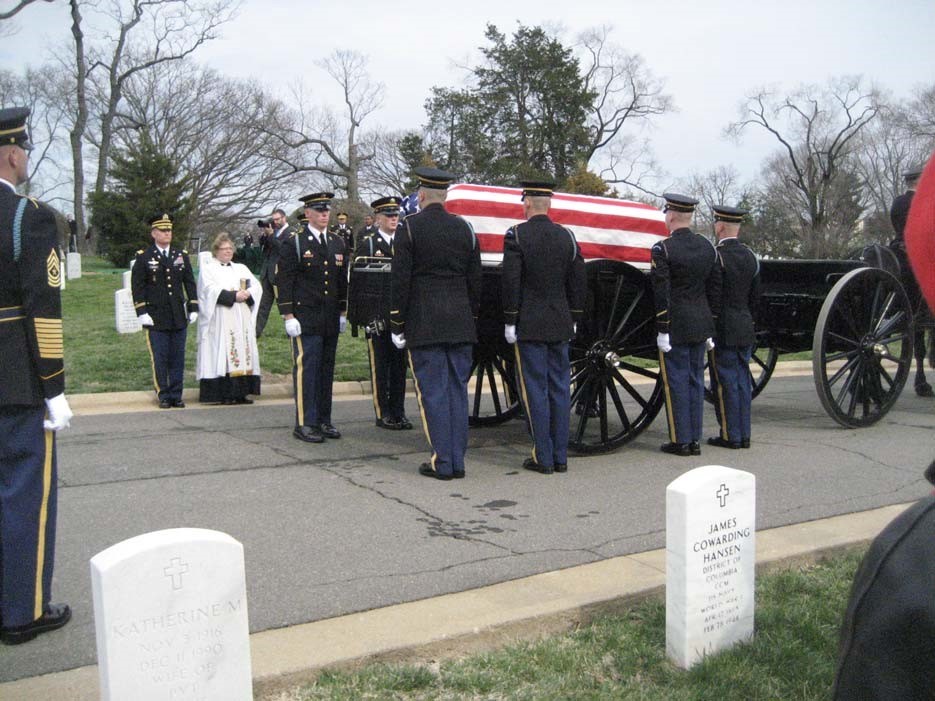
Buckles’s casket
Mr. Buckles’s casket on the horse-drawn caisson at Arlington National Cemetery, March 15, 2011. (Photo © Stuart Lutz)
Editor’s note: Stuart Lutz is a historian, and the author of The Last Leaf: Voices Of History’s Last Known Survivors. For the book, Lutz interviewed Frank Buckles, the last living Doughboy from World War I. Buckles died in 2011. Lutz attended Buckles funeral at Arlington National Cemetery on March 15, 2011, and wrote the article below.
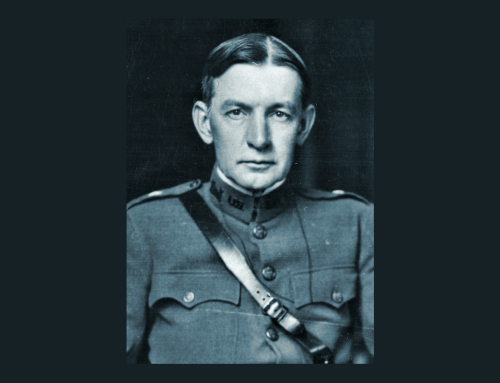
I gaze down into the last trench of the Great War, a rectangle dug ten feet deep into the holy hillside of Arlington, Virginia. It is March 15, 2011, and the dreadnaught grey skies threaten to drop rain like shrapnel. The soil will soon bundle the remains of Frank Woodruff Buckles, the last Doughboy who died weeks after his 110th birthday. The final memory flicker from the Great War. His Arlington grave is guarded by three appropriate wreaths. One, from the French, states “Lafayette We Are Here”, one is from his daughter, and another given by the Military Orders of the World Wars. Appropriately, Corporal Buckles will spend eternity one hundred feet from General Black Jack Pershing, the man who led America to victory over there.
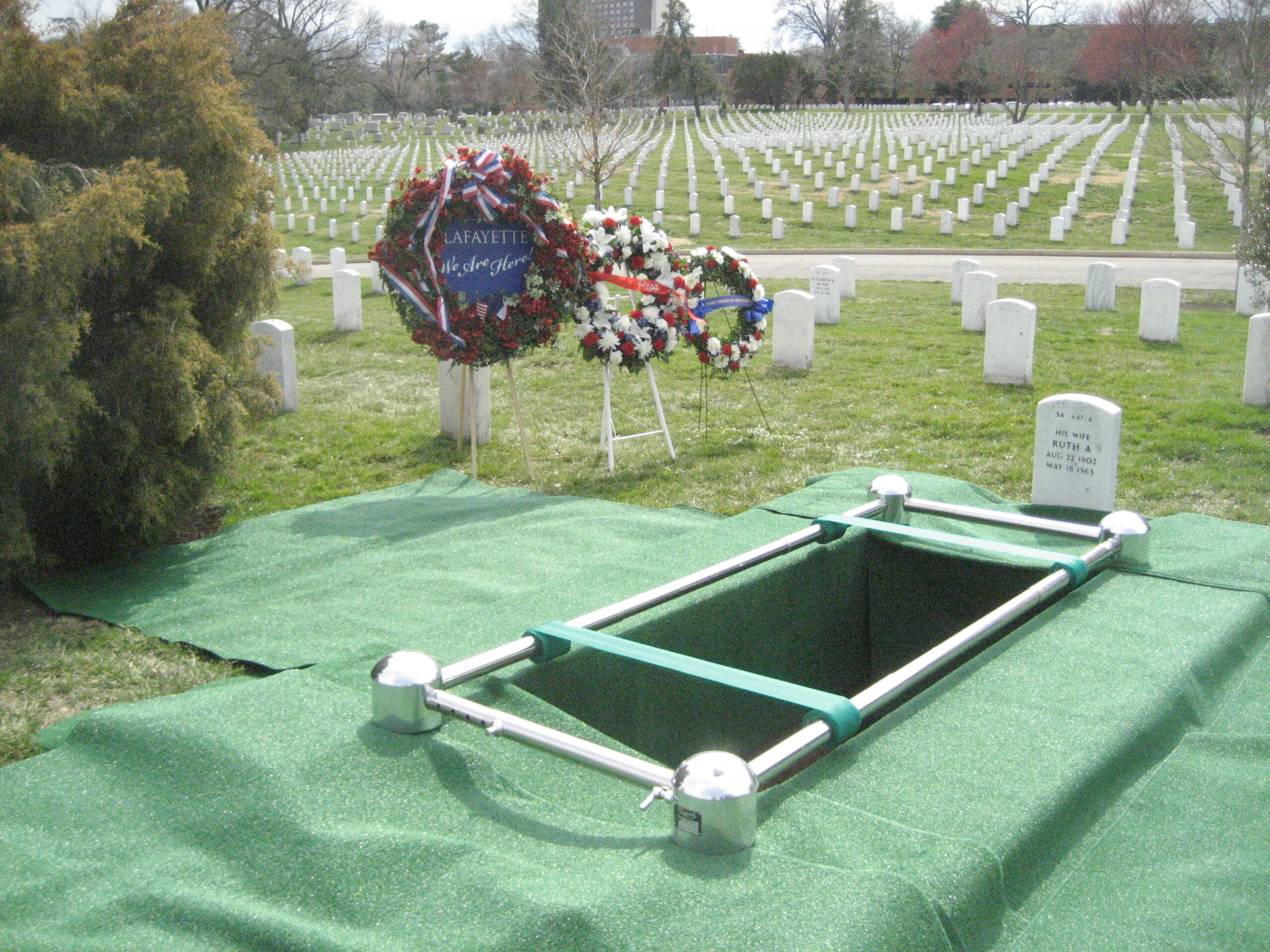
Wreaths at Frank Buckle’s grave site in Arlingtion National Cemetery prior to his ceremony on March 15, 2011. (Photo © Stuart Lutz)
The trench is a fitting symbol for World War I and its terrifying death. Nearly a century ago, young Germans, Aussies, Brits, Canadians, Frenchmen and Americans – most too young to drive – heard the command “over the top.” They scaled ladders and climbed out of their subterranean home littered with garbage and vomit, blood and casings. Some boys reached the top of the steps when lead death smashed through their helmet. Others managed to climb out, only to be threshed in the nihilistic No Man’s Land.
Warriors also met death in their own ditch. Thick mustard gas haunted across the treeless, lifeless plain, sniffing for prey. The great American baseball pitcher Christy Mathewson and a young German corporal named Adolph Hitler survived the poisonous cloud. For napping soldiers, a chemical attack made a temporary sleep permanent. The primitive gas masks were useless, except to muffle their death screams.
In December 1914, French troops refused to leave their trenches to attack the impregnable German lines. To teach all a lesson, the officers shot every tenth soldier. 600 bodyfulls of blood dripped into the soil. The French military thought it better to fight with a motivated ninety percent force.
On the historic day of Mr. Buckles’s burial, I leave New Jersey early for the funeral of an anachronism. I get in my car; Mr. Buckles was born years before the Model T. I have in my suit pocket a digital camera to record the ceremony; he was fourteen when the first true film, Birth of a Nation, was released. Once I get into southern New Jersey, I drive in soft focus, thinking of his remarkable American life. He was born in Missouri on February 1, 1901. As a teenager, he read of the Great War raging in Europe. When America entered the fight in 1917, he wanted to enlist, though he was too young. “Gosh,” I muse to the steering wheel, the mute earwitness to many monologues, “when I was sixteen, my big choices in life were playing football or basketball on Saturday.”
The eager Mr. Buckles spoke to several recruiters and was always turned down for his age. He tried the Army one last time when he was in Oklahoma. “No sir, I do not have a birth certificate,” he lied. “It is not required in Missouri. My birth is recorded in the family Bible, and it’s all the way back home. Take my word on it.” The recruiter believed the lie that young Frank was old enough to serve his country.
He sailed to England, then made it to embattled France, where he drove an ambulance. He did not see combat, only its black toll. After the Armistice, he worked with German POWs and returned to America when the parades were long over. “It is remarkable,” I think aloud, “he was born 111 years after George Washington was inaugurated and made it to 110. He lived through half the lifespan of the Federal government.”
I cross the Delaware River and see a giant flag only halfway up the staff. The President ordered all flags lowered that day to honor the 4.7 million Doughboys, now all dead, some of them nearly a century.
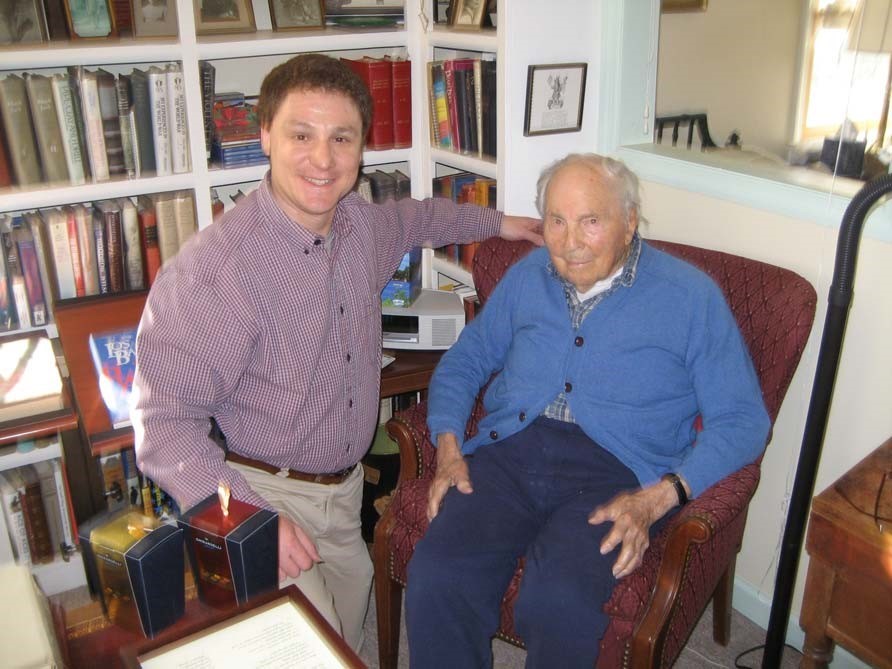
Stuart Lutz and Frank Buckles at Buckles’s home in West Virginia. Buckles was 107 in this photograph. (Photo © Stuart Lutz)
Three years earlier, I went to West Virginia to meet Mr. Buckles on his farm. He was a mere 107. I drove up the lengthy country road to his antique farm house and met his daughter Susannah. She was surprisingly young for the daughter of a World War I soldier since Mr. Buckles fathered her when he was well into his fifties. Mr. Buckles’s nurse escorted me into the music room, dominated by a piano and hundreds of worn history books on the shelves. I was soon summoned to the back of the house, where the slight Mr. Buckles sat in his sun room. He had ballerina bars built into the walls so he could walk from spot to spot. Mr. Buckles recounted his war-time service and his return to America. He said in his soft voice, “The American public forgot about the war quickly and veterans were disappointed in the attitude of the people. Most Americans couldn’t give a damn.” He placed his ancient Army cap on a daybed and showed me other memorabilia.
Another lowered flag flies over the Baltimore tunnel near Fort McHenry. My GPS estimates another ninety minutes to Arlington, a shrine originally denied to Mr. Buckles. He had not been killed in combat, nor did he win any heroic medals. His sole claim for burial was his status as the ultimate Doughboy, and the Army again barred him from entrance nine decades after the first time. Ross Perot heard of Mr. Buckles’s desire and called President Bush, who signed an executive order granting the old man his last wish.
I get on the DC beltway and see the Capitol dome. The Buckles family asked if he could lie in honor in the Rotunda, allowing ordinary Americans to say farewell to that great American generation. Inexplicably, House Speaker Boehner and Senate Majority Leader Reid denied this request. Mr. Buckles lay in Arlington’s white marble Memorial Amphitheater Chapel on the day of his burial. Few souls made the hilltop trek to pay their respects. He was prescient; most Americans still didn’t give a damn.
I get to the cemetery a little after one o’clock and I see the lowered flag flying over Robert E. Lee’s home. In that house, Lee fatefully declined command of the Federal Army. I am stopped by a guard. “I’m here for the Buckles funeral,” I announce, and she tells me to pull to the side and wait for further instructions. I see several television news trucks and a number of security officials with earpieces and dark suit jackets bulging with sidearms. I think that a bid odd. After a twenty minute wait and further questioning, I am told that I am not part of the official funeral and I must park in the visitor’s lot.
I sprint to the amphitheater so I could see his flag-draped coffin. I am too late. A massive Army officer instructs me, “No sir, you may not go any closer. The funeral is now open only to friends and family.”
I consult my cemetery map and stroll to the area where the burial will occur. I meet an old Army officer and we chat on the way. “Wow, you met Mr. Buckles,” he says. “I’m jealous! I’m just here to say goodbye. My uncle was killed in World War I.” We walk on the glistening grass, over the brave bones of dozens of American warriors. I must read the marble tablets. Some of the boys returned home, many did not.
At 2:30, I arrive at the open earth and claim a spectacular spot to watch. I chat with two nearby men roughly my age. One confesses, “I’m here to say goodbye to that generation” and the other laments, “I wish I had known about this earlier. I would have gotten my ten year old out of school so he could witness history.” We converse for fifteen minutes until approached by a muscular man with a military haircut. He looks like he was born with a permanent scowl. For him, the Army was the right career. “Folks, I am going to ask you to gather over there,” and points to a tree 150 feet away, across a road. Disappointed to lose our spot, we oblige. I stand next to a Buckles relative who could not get into the small funeral service.
For over an hour, I stand on a wonderful piece of Federal real estate five feet from the road. Every forty-five seconds, a passenger plane headed for Reagan National Airport passes overhead. “Those jets are a long way from a Sopwith Camel,” I think. The graveside preparations continue and the crowd is now a couple hundred citizens who give a patriotic damn. Mostly older Americans, but a few children too young to comprehend.
A few blacked out SUVs drive by. There is a rumor the President will attend. A massive motorcycle convoy gathers in the distance. A few reporters mill about. At 3:45, the Old Guard’s rifle squad marches to the side of the grave and stands ramrod straight. Army officers gather on the other side of the road, and they have an increasing number of uniform stripes. One takes a photograph of the crowd.
At four o’clock, by the amphitheater, Mr. Buckles’ silver casket is put on the horse drawn caisson by the honor guard. For the last meaningful time, the Army band plays George M. Cohan’s “Over There” as the horses make their half-mile march to the Doughboy’s perpetuity.
At a quarter after four, we hear brass music and reverentially hush. The band marches down the road to the left and behind us. It is followed by a squad of soldiers carrying the flag. A minute later, the rhythmic clopping of horses. Seven magnificent steeds, black as death, pull the shiny caisson less than ten feet away. Two of the horses have riders and the caisson is guarded by eight serious pallbearers marching in step. They stop before me. It is a spectacular sight. A moment later, I see Susannah being escorted by a handsome officer. Behind here are scores of family and friends, including the Secretary of the Army and West Virginia Senator Jay Rockefeller. I film it all.
The honor guard slowly takes the casket off the platform. Without a command, they sidestep to their left, then turn ninety degrees. They carry the soldier towards his grave. The steeds pull away. A horse drawn carriage is appropriate for his funeral. For millennia, man warred with horses as his equal, suffering partner. World War I was the last conflict to rely on equine power.
When the casket is above the grave and the family seated, the guards encourage the crowd to cross the road. I manage a spot behind a bush fifteen feet from the casket. I can hear the Christian services and I see the guard lift the flag from the coffin. A few minutes later, the riflemen fire three perfectly timed rounds. Then a single bugler, standing two hundred feet away, blows “Taps”. Those four mournful notes have wafted over these grounds too many times to remember.
As I look back towards the bugler, I see 150 leather-clad Patriot Riders in the distance, lined up and standing at attention. The band starts “America the Beautiful” as the flag is crisply folded. The pallbearers finish and march off. They seem impersonal; they had a noble job – one they had done hundreds of times – and they finished. The banner is presented to Susannah on behalf of a grateful nation.
The ceremony ends at 4:50 and the officers firmly ask the crowd to leave. The moment I walk back, a drizzle begins. I catch up with the two men I had chatted with before, and we discuss the event on the twenty minute walk. “Yes, the candle of memory is out,” one says to me.
I dine on the road and reflect on the memorable day on the long return drive. I get home at eleven. I am too wired to sleep, so I turn on the Military Channel at one in the morning. They are showing a documentary on the Great War. No longer do those images of shelling the enemy and flying biplanes reside in an American memory; all we have left now are black and white movies and rusty helmets and brittle letters home.
Stuart Lutz is the owner of Stuart Lutz Historic Documents, Inc. in South Orange, NJ. (www.HistoryDocs.com) He is a Member of the Professional Autograph Dealers Association, the Manuscript Society, the Antiquarian Booksellers Association of America, Certified Member of the Appraisers Association of America [Certified in the field of Historic Documents], the Universal Autograph Collectors Club (Registered Dealer #166) and the Ephemera Society. He is also the historic autograph authenticator for the History Channel program Pawn Stars, and author of The Last Leaf: Voices of History’s Last-Known Survivors (Prometheus Books, 2010).
External Web Site Notice: This page contains information directly presented from an external source. The terms and conditions of this page may not be the same as those of this website. Click here to read the full disclaimer notice for external web sites. Thank you.