From Campus to the Trenches. How World War I Transformed American College Students
Published: 27 February 2026
By Helga Kornstone
Special to the Doughboy Foundation website
28-0669a
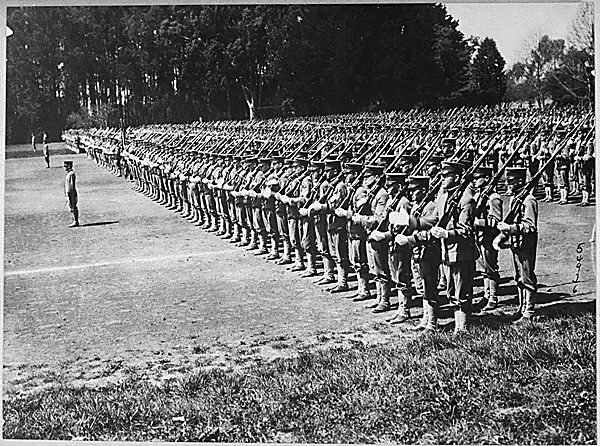
University of California Student Army Training Corps students inspection drill on the University Campus at Berkeley, California in 1918.
In the spring of 1917, American university auditoriums were packed with talks on literature, law, and engineering. Only a few weeks after Woodrow Wilson persuaded Congress to declare war on Germany. Thousands of students deserted their universities. They headed for training camps. The question “when did WWI start” had little abstract significance for them in 1914, but rather a concrete dimension of personal choice in 1917. That is, when the United States entered the conflict. For a generation of young Americans, the university ceased to be an isolated space of intellectual freedom. It became part of the national mobilization. World War I became a turning point for student identity, the structure of higher education, and the role of universities in society. Campuses were transformed into centers of military training. Laboratories became sites for research needed by the front. The concept of civic duty took on a new and dramatic meaning.
World War I. Mobilization of Campuses
On April 6, 1917, Congress declared war. Universities immediately felt the consequences. Why did the US enter WWI was a question discussed not only in political circles, but also in student clubs. German submarine warfare against merchant ships and the Zimmermann Telegram were the catalysts. However, for students, the decision meant practical changes:
- Deferments from conscription were limited;
- Education no longer guaranteed protection from service.
Many institutions saw a sharp decline in the number of male students. The number of students at Harvard University declined dramatically during the 1917-1918 academic year due to voluntary enlistment and mobilization. Similar processes occurred at the University of Michigan and Columbia University. Campuses were emptied. Traditional student activities were restricted or canceled.
Student Army Training Corps
In 1918, the federal government created the SATC. The program allowed students to remain formally enrolled in universities while undergoing military training directly on campus.
It was an unprecedented combination of academic and military life. The SATC changed the daily rhythm of universities. Instead of traditional schedules, there were:
- Drill exercises;
- Weapons training;
- Mandatory courses in military engineering.
Students wore uniforms, and teachers collaborated with army instructors. Thus, the World War I period integrated military discipline into the academic space.
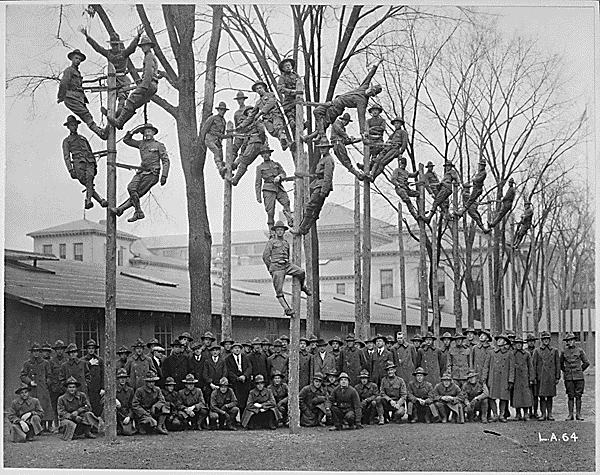
Vocational training for Student Army Training Corps members at the University of Michigan, Ann Arbor. Class in Pole-Climbing were part of the course for telephone electricians, with some of their instructors.
Intellectual Work for the Nation’s Service
After the first wave of mobilization, it became clear that the war required not only soldiers, but also knowledge. University laboratories joined in the development of:
- Communication technologies;
- Chemical protection;
- Medical solutions.
Researchers collaborated with government agencies. Scientific activity became part of the military strategy. Along with patriotism, pressure also fell on students. They had to study military affairs and at the same time not neglect their academic knowledge. And although the situation is now radically different from what it was at that time, today’s students often feel no less pressure from burning deadlines or other reasons. However, modern students have significantly more opportunities than before. They can use online help at any time and ask professionals to write my homework. This should not be perceived as something wrong, but as a necessary step when the pressure of responsibilities becomes excessive. The most important step is to make the right choice and select a high-quality service. There are many such services available now, but this should not confuse you. In particular, there is one that stands out for its professional approach and the expertise of its authors. With EduBirdie authors, you can be sure not only of timely completion, but also of high-quality work, regardless of the topic. You will also be offered an individual approach. So, you will have more free time and will be able to delve even deeper into researching the topic of how World War I transformed American college students.
Propaganda. Academic freedom
World War I influenced the intellectual climate. Universities became centers of patriotic mobilization. Some professors who criticized the war or questioned the administration’s policies were pressured or even dismissed. Academic freedom had developed over previous decades. But it was limited under the influence of wartime. Students organized rallies in support of the army. They raised funds for war bonds and participated in Red Cross campaigns. The campus became a space where a new model of civic responsibility was formed, one based on service to the state.
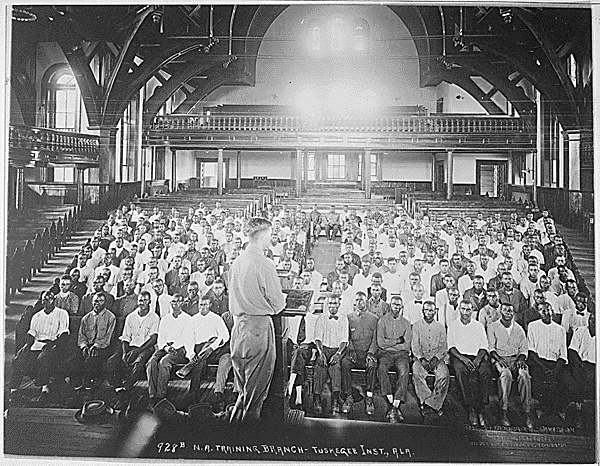
Lecture for the Student Army Training Corps at Tuskegee Normal and Industrial Institute, Tuskegee, Alabama., in 1918.
Frontline Experience. Long-Term Changes in American Higher Education
Thousands of students joined the American Expeditionary Forces. They were sent to Europe. For many of them, the transition from lecture halls to the trenches of France was a shock. They were confronted with the realities of trench warfare and mass casualties. Among the well-known WWI facts is that more than 116,000 American soldiers died. These data include the names of former students whose studies were cut short for good. University memorial plaques erected after the war became a symbol of how deeply World War I changed academic communities.
Psychological consequences. Returning home
After the armistice on November 11, 1918, student veterans returned to their studies. However, the experience of war changed their worldview forever. Many suffered from what was then called “shell shock.” Today, this is known as post-traumatic stress disorder. Adapting to peaceful life was difficult because universities did not yet have developed psychological support systems. Students returned more mature and often critical of the romantic notions of war that had dominated at the beginning of the conflict.
The state recognized the critical importance of colleges to national security. The cooperation between the federal government and academic institutions, which began during the war, lay the groundwork for future initiatives. This was especially true during WWII and the Cold War.
Returning veterans frequently became leaders in social movements. Their experiences molded a new generation of citizens who recognized the consequences of foreign warfare.
The conflict helped to expand women’s roles. As many males walked to the front, women took their seats in classes and laboratories. This hastened the processes that led to greater recognition of women’s participation in higher education and the workplace.
Conclusion
The war changed the structure of universities, the content of education, and the very understanding of student identity. Campuses became part of the war machine. Young people became soldiers and community activists at the same time. The experiences of this generation demonstrate that universities do not operate in a vacuum. When a country goes to war, the intellectual community is inexorably drawn into the conflict. World War I made a lasting impact on American schools. It set the course of higher education for decades to come. For current readers, this narrative serves as a reminder of the vulnerability of a pleasant learning atmosphere.
 A historian of education and military transformations of society in the early twentieth century. In her writing, she mixes academic accuracy with a humanistic perspective, focusing not only on statistics or political decisions, but also on human experience. Kornstone’s works aim to make complex historical processes intelligible to modern readers while maintaining a mix of scientific rigor and emotional depth.
External Web Site Notice: This page contains information directly presented from an external source. The terms and conditions of this page may not be the same as those of this website. Click here to read the full disclaimer notice for external web sites. Thank you.