Iran demonstration at National World War I Memorial recalls current conflict’s direct links to WWI
Published: 28 February 2026
By Doughboy Foundation Staff
Iran header image
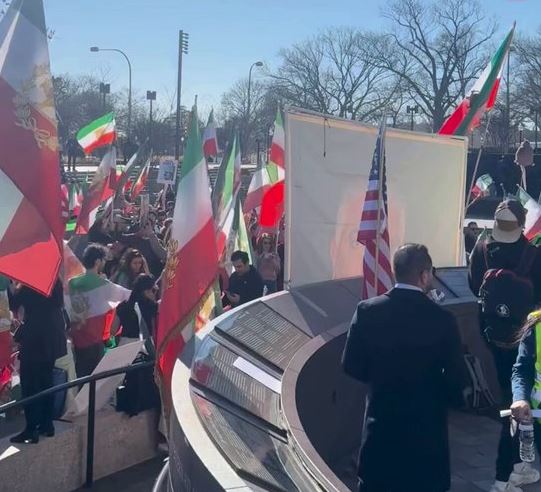
Looking south from the rotunda at the National World War I Memorial in Washington, DC at the sea of traditional Iranian flags held by a large crowd celebrating the U. S. strike on the leadership of the Iranin government on February 28, and the hoped-for fall of the current Iranian regime.
The irony of the event being at WWI Memorial not lost
Some hours after the United State’s military strike against the leadership of the Iran regime on Saturday, February 28, a large crowd gathered at the National World War I Memorial in Washington, DC, just across the street from the White House. The gathering waved the traditional Iranian flag, celebrated the U.S. military action, and called for the complete overthrow of the Iranian government.
Wow it’s crazy in downtown dc right now as hundreds of Persians descend on the White House to celebrate the ouster of the Iranian Islamic regime pic.twitter.com/ia83aU5O8t
— Raheem J. Kassam (@RaheemKassam) February 28, 2026
Wow it’s crazy in downtown dc right now as hundreds of Persians descend on the White House to celebrate the ouster of the Iranian Islamic regime
— Raheem J. Kassam (@RaheemKassam) February 28, 2026
The selection of the National World War I Memorial as the site of the demonstration may have been happenstance, but the history of modern Iran, like that of so many nations, is inextricably connected to, and still affected by, events of the Great War a century later, making the location of the demonstration very, even if unintentionally, ironic.
Iran declared neutrality at the start of World War I in November 1914, but its strategic location and oil resources made it a battleground despite its non-belligerent stance. The conflict rapidly drew in foreign powers: the British Empire occupied southern Iran, the Russian Empire controlled the north, and the Ottoman Empire invaded western regions, leading to a prolonged struggle for control. Local forces, tribes, and even a Provisional National Government in Kermanshah, backed by German sympathizers, emerged amid the chaos.
The war devastated Iran, causing a catastrophic famine (1917–1919) that killed 8 to 10 million people—about half the population—due to war-related disruptions, foreign occupation, and economic collapse. The Qajar government’s authority disintegrated, and foreign powers manipulated Iranian politics, with Britain emerging as the dominant influence after Russia’s withdrawal following the 1917 Revolution. The Anglo-Persian Agreement of 1919, which sought to establish British control, was rejected by the Iranian parliament, fueling nationalist discontent.
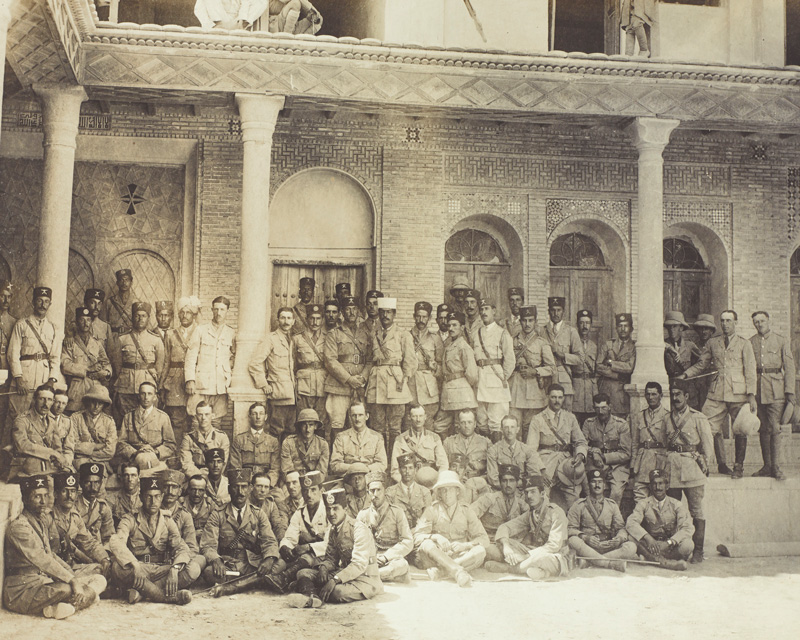
British and Persian officers of the South Persia Rifles, 1918 (UK National Army Museum)
These conditions paved the way for Reza Khan, a military officer, to seize power in a 1921 coup. He later deposed the Qajar dynasty in 1925 and founded the Pahlavi dynasty, marking a decisive shift in Iran’s modern history. World War I thus became a turning point, ending centuries of Qajar rule and setting the stage for the rise of modern Iran.
(During World War I (1914–1918), the nation was still internationally known as Persia. The official name change to Iran did not occur until 1935, when Reza Shah requested that foreign governments use the native name “Iran” in diplomatic correspondence. Prior to that, “Persia” was the exonym used by Western countries, while Iranians referred to their country as Iran. The reason for the change by the Shah was to align the country’s international name with its native designation—Iran, meaning “Land of the Aryans,” had been used internally for centuries. The change emphasized national identity and pre-Islamic heritage, distancing from the Western term “Persia,” derived from the ancient province of Pars (Fars).)
Pre-World War I
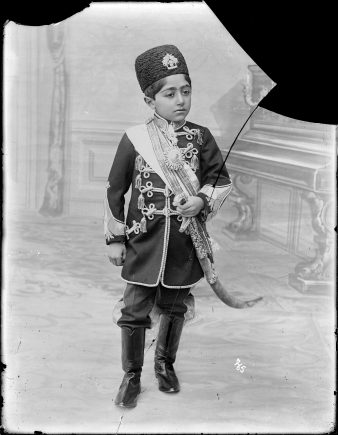
The last Qajar ruler, Ahmad Shah, came to the throne at the age of eleven and was under the control of regents until his coronation in 1914.
The Persian government under the Qajar dynasty had been in place for approximately 100 years prior to World War I. The Qajar rule began in 1789 until 1925, the dynasty ruling for about 125 years from its foundation to the outbreak of the WWI.
The Qajars reunified Iran after a period of fragmentation following the fall of the Safavid dynasty and ruled during a time of increasing foreign influence, territorial losses to Russia, and internal reforms such as the Constitutional Revolution of 1906.
The Safavid dynasty ruled Persia from 1501 to 1722, a period of 221 years. They established Shia Islam as the state religion and are credited with shaping the modern Iranian identity. Their rule ended after an Afghan invasion captured the capital, Isfahan.
The Safavid dynasty was preceded by several regional powers, but the most immediate predecessors were the Aq Qoyunlu (“White Sheep Turkomans”) and the Timurid Empire. The Aq Qoyunlu ruled western Iran and surrounding areas from 1468 to 1508, and their decline created a power vacuum that allowed Ismail I to establish the Safavid dynasty in 1501 after defeating the Aq Qoyunlu at the Battle of Sharur.
Significant Campaigns and Battles in Iran During WWI
Iran remained officially neutral during World War I, but its territory became a battleground due to its strategic location and oil resources. The conflict, known as the Persian Campaign, involved the Ottoman Empire, British Empire, and Russian Empire, with local Persian forces and tribes also participating.
Key Campaigns and Battles During World War I
- Ottoman Advances in Northwestern Iran (1914–1915)
- In December 1914, Ottoman forces captured Qoturand advanced toward Khoy and Tabriz.
- In January 1915, they briefly occupied Tabrizand Urmia, but Russian forces quickly recaptured Tabriz by January 30.
- The Battle of Dilman (April 1915)saw Armenian volunteer units under General Andranik Ozanian repel Ottoman forces, forcing their retreat.
- Russian Operations in Iranian Azerbaijan
- Russia, already present in northern Iran under the 1907 Anglo-Russian Agreement, used its Caucasus Armyand the Persian Cossack Brigade to maintain control.
- In November 1915, Russian forces under General Nikolai Baratovcaptured Hamadan and Kermanshah, securing central and western Iran.
- By the end of 1915, Russian troops also occupied Tehran, effectively controlling the capital.
- British Involvement and the South Persian Rifles
- The British focused on protecting oil fields in the south, especially after the 1908 discovery of oil in Masjed Soleyman.
- In 1915, British forces occupied Bushehrand later expanded into Shiraz and Kerman.
- In 1916, the British formed the South Persian Rifles, a local force to counter German and Ottoman influence in the south.
- German Subversion and Wilhelm Wassmuss
- German agent Wilhelm Wassmuss, known as the “German Lawrence,” led efforts to incite tribal revolts against British rule.
- He briefly captured Bandar Abbasin 1915 and distributed weapons to tribes like the Qashqai, though these uprisings had limited strategic impact.
- Impact of the Russian Revolution (1917)
- After the February 1917 Revolution, Russian forces collapsed, withdrawing from Iran.
- This created a power vacuum, allowing Ottoman forces to re-enter Tabrizand Urmia in 1918.
- Dunsterforce (1918)
- A British mission led by Major-General Lionel Dunstervilleaimed to secure the Caspian region and support anti-Ottoman forces.
- Though small in number, Dunsterforce advanced through Hamadanto Baku, playing a symbolic role in countering Ottoman and German influence.
The End of the War
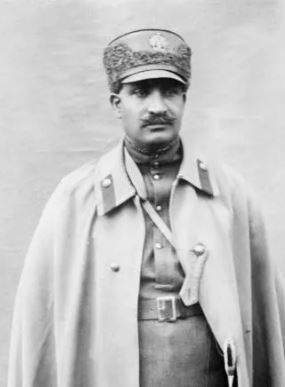
Reza Khan in 1925
Iran did not regain full domestic control immediately after World War I ended in 1918. Foreign occupation continued, and the Qajar government remained weak and ineffective. The turning point came in February 1921, when Reza Khan, an officer in the Persian Cossack Brigade, led a coup d’état with British support. He seized control of Tehran, forced the Qajar Shah to appoint him Minister of War, and gradually consolidated power.
By 1923, Reza Khan became Prime Minister with dictatorial authority. In 1925, he deposed the Qajar dynasty and established the Pahlavi dynasty, crowning himself Reza Shah Pahlavi. This marked the return of centralized domestic control and the beginning of modern Iran.
In these early post-war days, Arthur Millspaugh, an American economic adviser, was sent to Iran in 1923 to help reform the government’s finances.
World War I Memorials in Iran
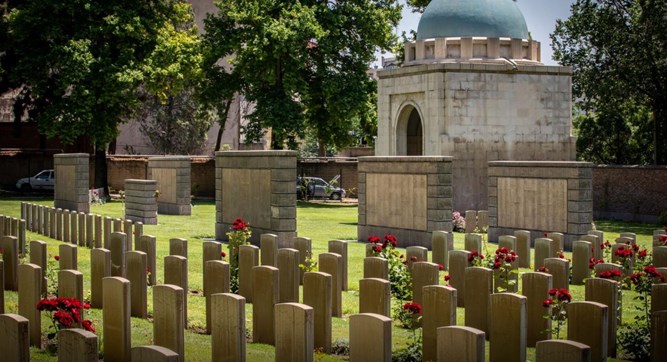
Tehran- War Cemetery and-Memorial (IFP News photo)
The Tehran War Cemetery holds the graves of hundreds of members of the British forces who died in Irn during the fighting in World War I, as well as soldiers from India and other members of the British Commonwealth. Within the Tehran War Cemetery is the Tehran Memorial, which lists those who died in the WWI up to August 1921. It comprises six free standing walls which contain panels on both sides of each structure. These panels are ordered by the army in which the men served – firstly British then Indian.
Read an in-depth examination of the World War I Memorials in Iran on the Western Front Association website here.
External Web Site Notice: This page contains information directly presented from an external source. The terms and conditions of this page may not be the same as those of this website. Click here to read the full disclaimer notice for external web sites. Thank you.