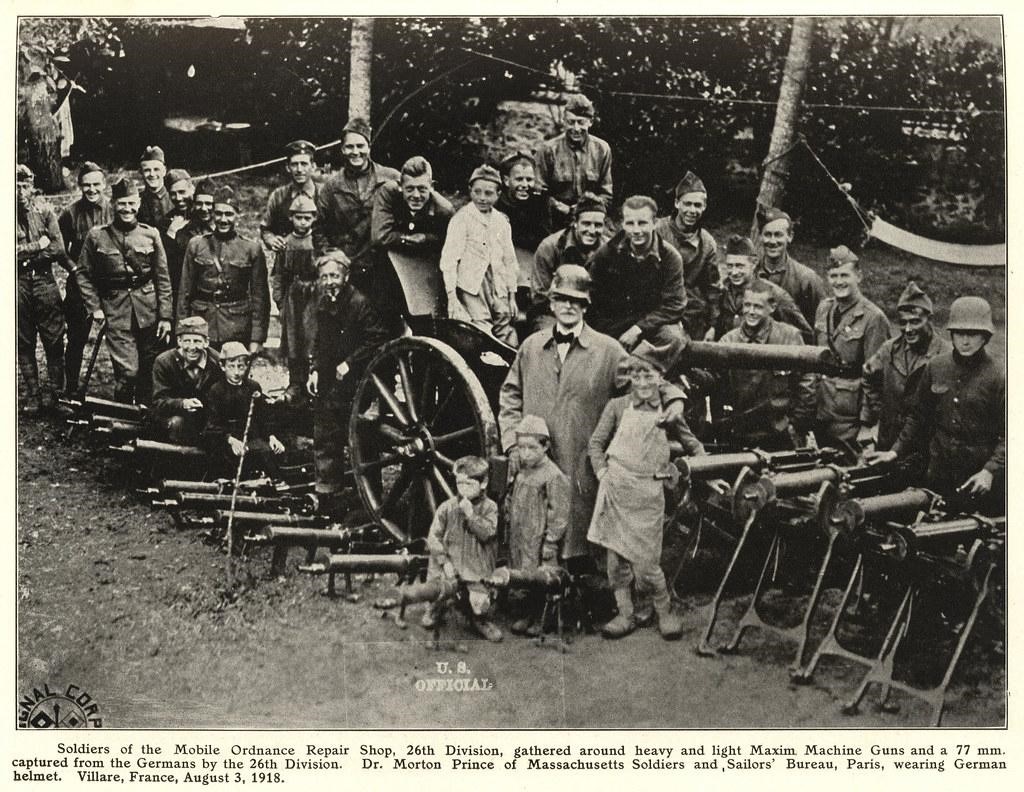
The 101st Mobile Ordnance Repair Shop of the 26th Yankee Division
Published: 16 February 2026
By Michael Santoro
Special to the Doughboy Foundation website
Taylor framed
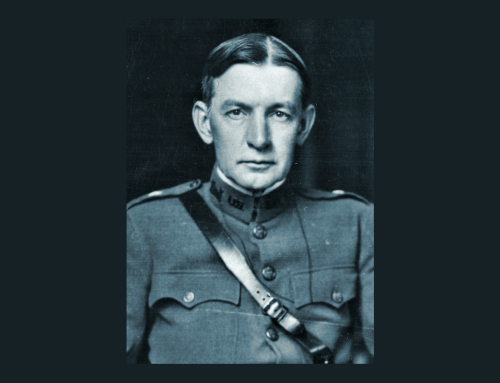
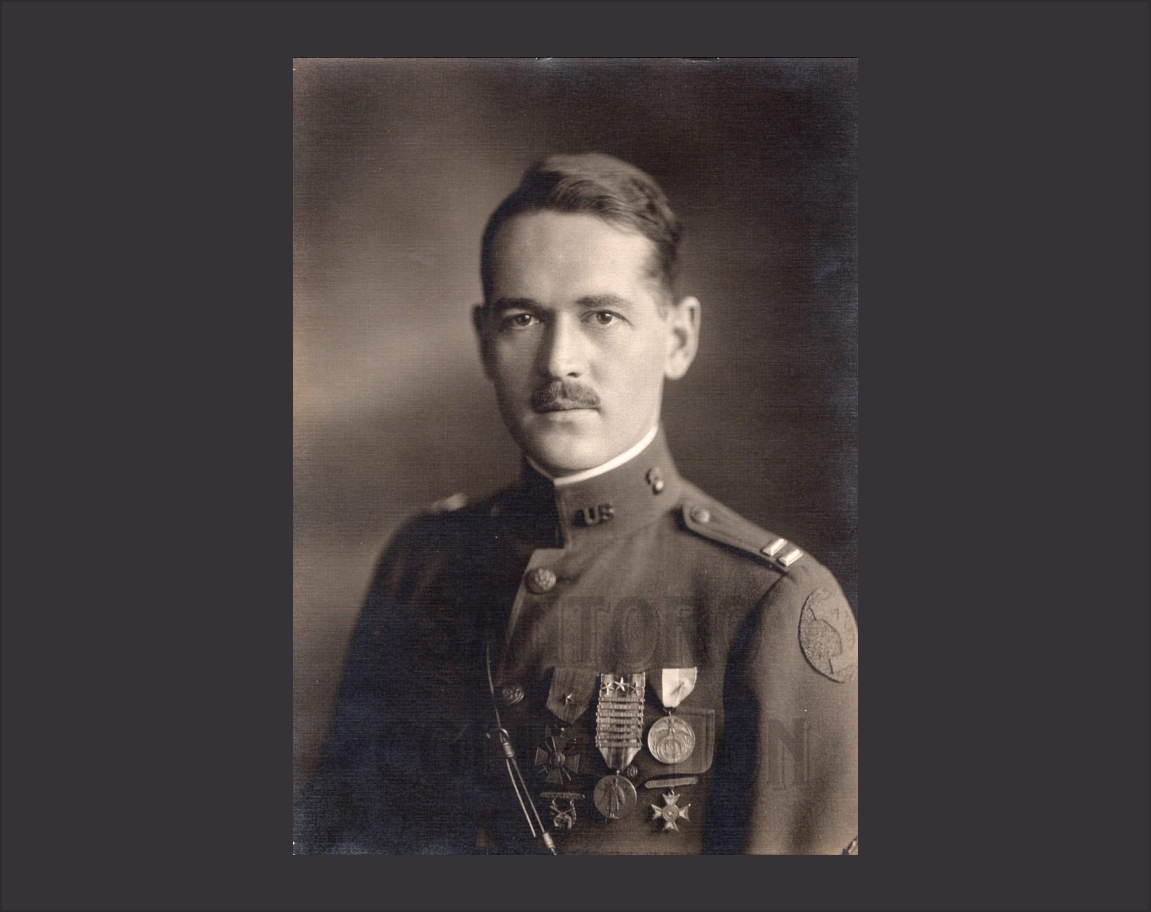
Captain Paul Huse Taylor, the commanding officer of the 101st Mobile Ordnance Repair Shop.
The Remarkable Service of Captain Paul Huse Taylor
This is a lovely portrait taken around 1921 of Captain Paul Huse Taylor, the commanding officer of the 101st Mobile Ordnance Repair Shop, or MORS, 26th Division. Most readers have likely never heard of such a unit, but there were a great deal of them serving within the AEF from 1917-1918, and their contributions were critical to the Allied victory.
M.O.R.S units were organized stateside. Following induction, Soldiers were interviewed to determine who were best suited for certain jobs based on their previous civilian experience before they were sent to the appropriate school. Soldiers would be selected to attend the “various ordnance, saddler, machine gun, and artillery schools.” Due to the burgeoning numbers of Ordnance Soldiers, the Ordnance Department established schools at a variety of its current locations (arsenals, depots, etc…), and expanded into civilian organizations including factories and colleges.
Each M.O.R.S. was broken into an Equipment Section and Machinery Section. The Equipment Section focused on small arms and consisted of three repair trucks and two supply trucks. The Machinery Section addressed artillery repairs and possessed three artillery repair trucks and three supply trucks. Some units included motorcycles with sidecars to affect quick, emergency repairs.
But how did new MORS units know how to navigate the Western Front? What precedence was there for them to reference? One of the very first M.O.R.S. units was organized in France, the commander of which laid the foundation for the units that came after.
Captain Paul Huse Taylor was born in Wakefield, Massachusetts, August 21, 1892. He graduated from the Massachusetts Institute of Technology (MIT) in 1914. He entered the Officers Reserve Corps, United States Army as 2nd Lieutenant, April 2, 1917, and was called into the Engineers Corps on May 8, 1917. He was made 1st Lieutenant, Ordnance Department on August 17, 1917, departing from New York on September 8, 1917 and arriving in France on October 2, 1917, where he reported to the Artillery School at Valdahon, Le Haute on October 6, 1917. He reported at Chaumont for Staff duty, October 29, 1917, where he was ordered to Camp Coetquidan, Morbihan, as Commanding Officer, 101st Mobile Ordnance Repair Shop, 26th Division.
Taylor was wounded by shrapnel in the leg on April 10, 1918, at Seichprey, and gassed at Chateau-Thierry, August 1, 1918. He was appointed Inspector of all Ordnance material, April 30, 1918, and from that date until November 1, 1918, he never left the front for more than forty-eight hours, being actively engaged in every battle of the 26th Division to September 20, 1918; also of the 1st Army until November 11, 1918, as Inspector of Artillery and Ammunition. He was appointed Captain, August 1918, but did not receive his commission until April 1919. This would explain why his Captain’s bars are two 1st Lieutenant bars. Taylor’s Victory Medal bears three large silver citation stars over seven campaign bars including Somme Defensive, Aisne, Aisne-Marne, Oise-Aisne, St. Mihiel, Meuse-Argonne, and Defensive Sector. This is one of the rarest bar combinations.
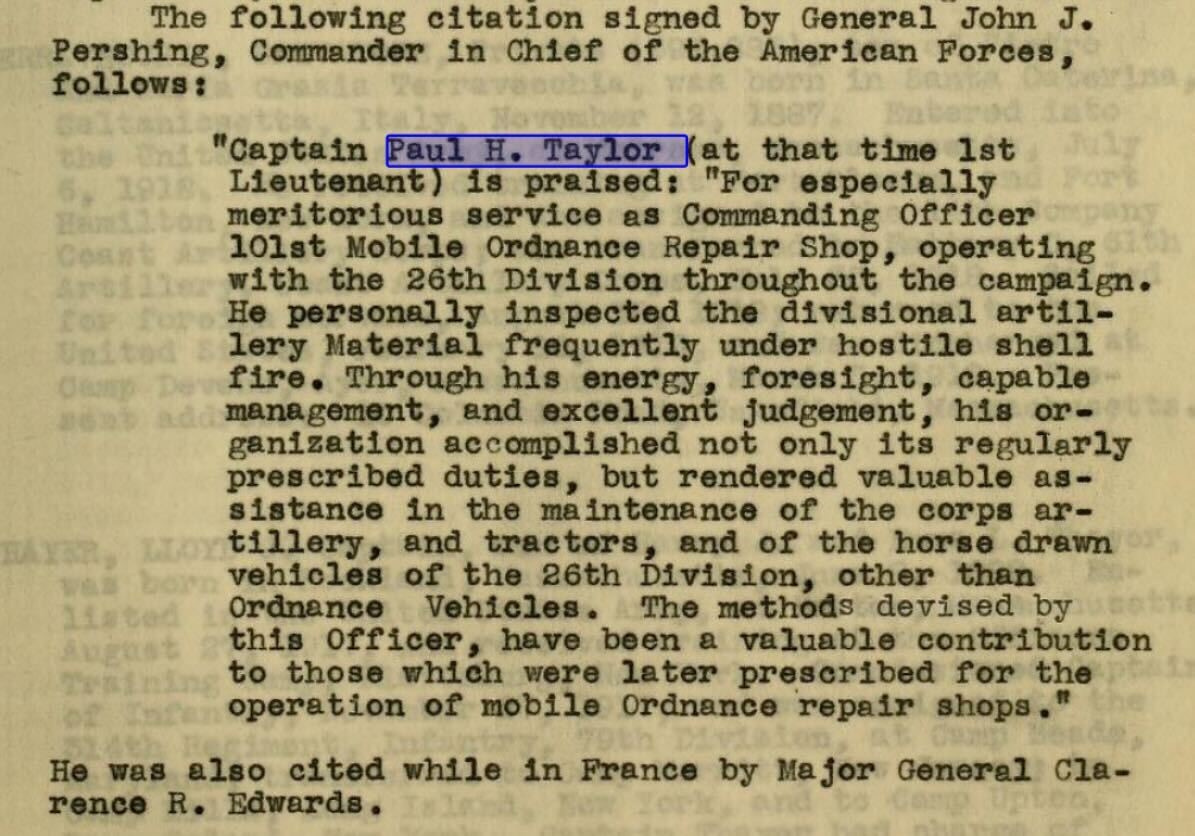
Taylor was cited by General Pershing:
“1st Lieutenant Paul H. Taylor is praised for especially meritorious service as Commanding Officer, 101st Mobile Ordnance Repair Shop, operating with the 26th Division throughout the campaign. He personally inspected the divisional artillery material frequently under hostile shell fire. Through his energy, foresight, capable management, and excellent judgement, his organization accomplished not only its regularly prescribed duties, but rendered valuable assistance in the maintenance of the corps artillery, and tractors, and of the horse drawn vehicles of the 26th Division, other than Ordnance Vehicles. The methods devised by this Officer, have been a valuable contribution to those which were later prescribed for the operation of mobile ordnance repair shops.”
Taylor was also cited while in France by Major General Clarence R. Edwards, commander of the 26th Division, and he later received the Croix de Guerre with Bronze Star.
Captain Taylor died on July 24, 1928 at the age of 35, and was buried with full Military Honors in his hometown at Lakeside Cemetery, Wakefield, Massachusetts, Crosscup Pishon Post, American Legion acting as Guard of Honor. The portrait was not named, but thankfully I was able to identify his Wakefield, MA Victory Medal, which led to the confirmation of his identity.
Thank you to the Doughboy Foundation for the opportunity to share Captain Taylor’s story!
Michael R. Santoro is a historic researcher & preservationist of the First World War. After finishing his Bachelor’s and Master’s degrees in Architecture & Historic Preservation at the University at Buffalo, New York, he spent a year developing a museum in Gettysburg, Pennsylvania, and another year freelancing research in order to preserve the stories of soldiers long forgotten. He now provides historic research for several militaria companies, and runs his own business, Santoro Military Researchers, providing quality & affordable military research.
External Web Site Notice: This page contains information directly presented from an external source. The terms and conditions of this page may not be the same as those of this website. Click here to read the full disclaimer notice for external web sites. Thank you.